
Water cooler or water dispenser?
In commercial projects, the two terms are often used for similar equipment. But the name alone tells you very little about the actual system, and different suppliers may use the terms in different ways.
A better approach is to look at the equipment itself.
Where does the water come from? What does it provide? How is it installed? What treatment does the water need? How will the unit be serviced?
For distributors, builders, installers, and project buyers, these questions are far more useful than the label on the brochure.
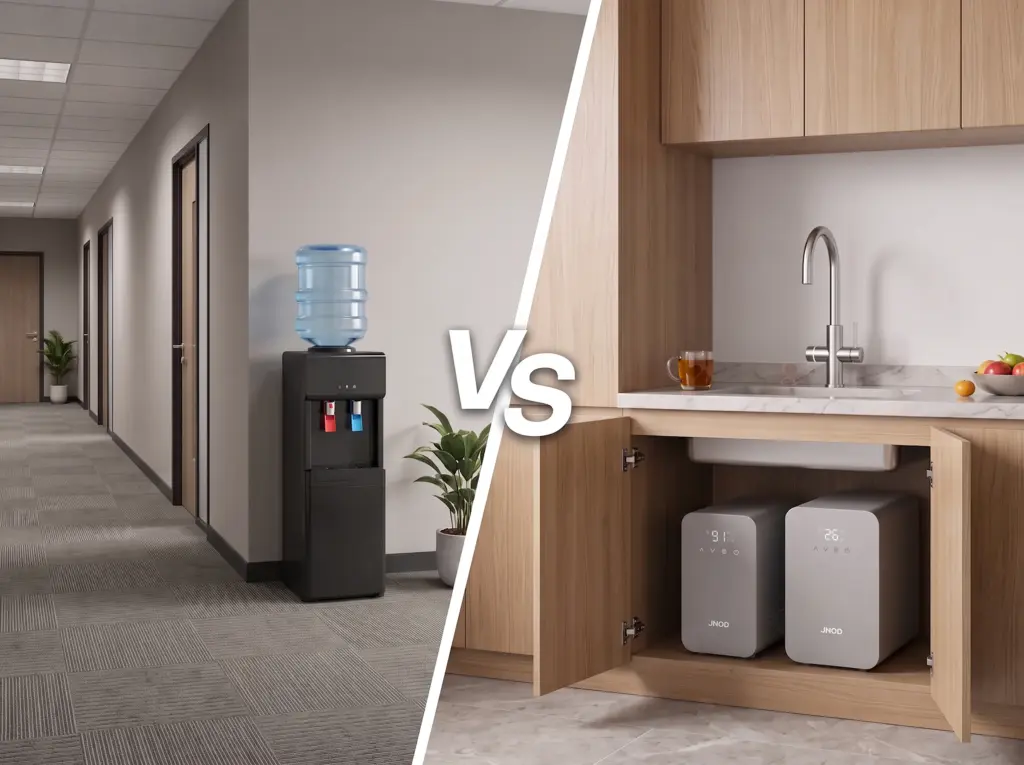
Are a Water Cooler and a Water Dispenser the Same?
Often, they overlap.
In common use, a water cooler usually emphasizes chilled drinking water. A water dispenser is often used more broadly for equipment that can dispense chilled, hot, ambient, sparkling, or filtered water.
The terminology is not standardized across every supplier or market.
One manufacturer may call a direct-connected chilled unit a water cooler. Another may use “water dispenser” for a similar product.
So, when comparing products, read the specification first.
That tells you more than the product name.
Bottled vs. Bottleless: How Is the Water Supplied?
For a commercial buyer, this is often the first practical distinction to make.
Bottled or Jug-Fed
A bottled system uses a replaceable container.
The installation can be relatively simple because it may not need a permanent connection to the building water supply. This can be useful for temporary spaces, sites without suitable plumbing, or projects where building work needs to stay limited.
The trade-off is handling.
Bottles need to be delivered, stored, lifted, and replaced. Empty containers also need to be collected or disposed of.
For a small site, that may be manageable.
For a larger operation, bottle logistics become part of the operating model.
Bottleless or Point-of-Use
A bottleless system connects to the building water supply and dispenses water at the point of use.
Depending on the design, the water may be filtered, chilled, heated, or carbonated before it reaches the faucet. The U.S. EPA uses the term point-of-use (POU) for treatment carried out at the location where water is used, including systems serving a dedicated drinking-water outlet or installed under a sink.
For offices and commercial spaces, a point-of-use system can reduce bottle storage and delivery handling. It can also make it easier to integrate the equipment into a pantry, kitchen, bar, or beverage station.
The important distinction is not “cooler” versus “dispenser.”
It is often how the water gets to the machine.
What Does the Equipment Actually Provide?
The product category does not tell you the full function set.
A chilled-water unit may be called a cooler. Another model may offer hot, chilled, sparkling, and filtered water under the broader name of a dispenser.
Look at the water function separately.
| Water Function | What It Usually Means |
|---|---|
| Chilled | Cooled drinking water |
| Hot | Heated water for coffee, tea, and similar uses |
| Sparkling | Carbonated drinking water |
| Ambient | Water supplied without active heating or cooling |
| Filtered | Water that passes through a specified treatment stage |
Chilled Water
Chilled water is the classic cooler function.
For commercial equipment, check the rated output, flow rate, cooling capacity, inlet-water temperature, and recovery performance. JNOD’s chilled water dispenser range covers different drinking-water applications and configurations.
Hot Water
Hot water is useful when the same water point supports coffee, tea, instant beverages, or light food preparation.
An instant hot water dispenser can provide hot water on demand, with different temperature ranges and installation formats available across product models.
Sparkling Water
Sparkling water is a separate function.
It is common in cafés, restaurants, hospitality spaces, meeting areas, and other beverage-focused applications. When comparing these systems, check carbonation output, cooling performance, CO₂ supply, and service access.
JNOD’s countertop sparkling and chilled water dispenser is one example of a system that combines multiple water functions.
The product name still does not tell you enough.
The Three Parts of a Real Specification
For commercial water equipment, it helps to separate three things:
1. Water Source
Where does the water come from?
Bottled.
Direct connection.
2. Water Function
What should the equipment do?
Chill.
Heat.
Carbonate.
Dispense at ambient temperature.
3. Water Treatment
How should the incoming water be treated?
Carbon filtration.
Reverse osmosis.
Softening.
Scale control.
These are separate specifications.
A bottleless dispenser is not automatically a filtered dispenser.
A water cooler is not automatically a hot-and-cold system.
A carbon block filter is not automatically a scale-control system.
Separating these three layers makes product comparison much clearer.
Water Cooler vs. Water Dispenser: Key Differences
| Factor | Water Cooler | Water Dispenser |
|---|---|---|
| Common usage | Often associated with chilled water | Broader term for water-dispensing equipment |
| Water source | Bottled or direct connection | Bottled or direct connection |
| Water functions | Usually chilled, sometimes hot | Chilled, hot, ambient, sparkling, filtered, depending on model |
| Installation | Floor-standing, countertop, or point-of-use | Floor-standing, countertop, under-counter, or integrated |
| Filtration | Depends on the system | Depends on the system |
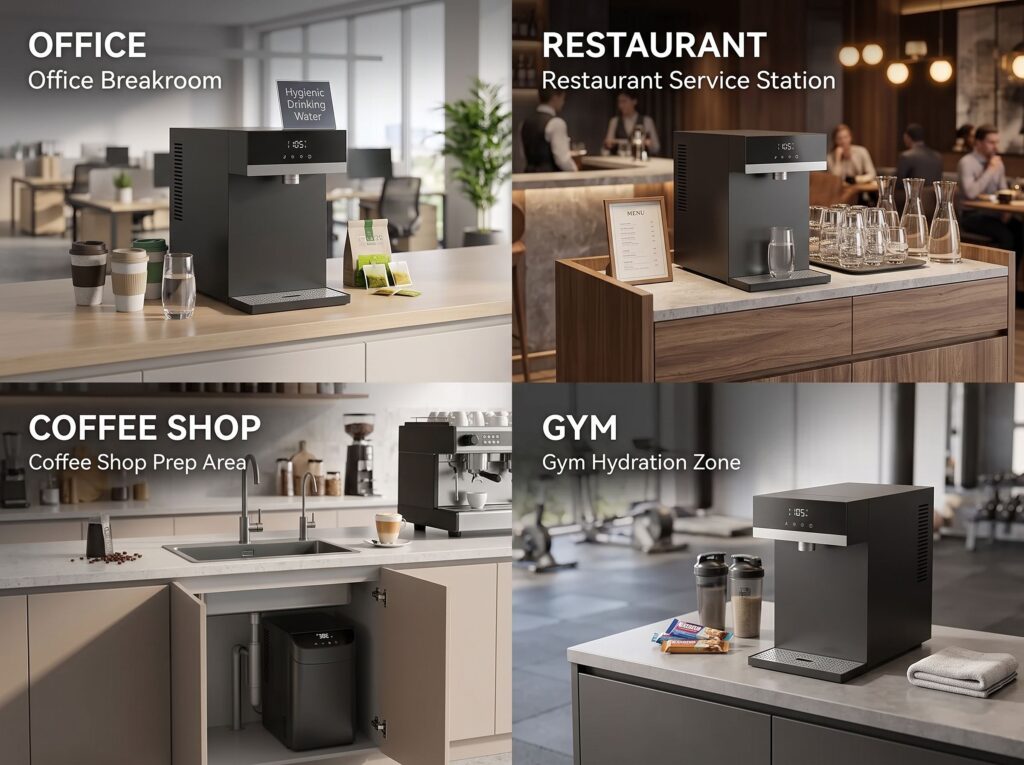
| Commercial applications | Offices and shared spaces | Offices, kitchens, cafés, restaurants, hospitality, and other commercial sites |
This is a practical comparison, not a universal industry definition.
Suppliers may use the same term for different configurations. Check the actual specifications before making a purchase decision.
Does Installation Format Matter?
It can change the whole project.
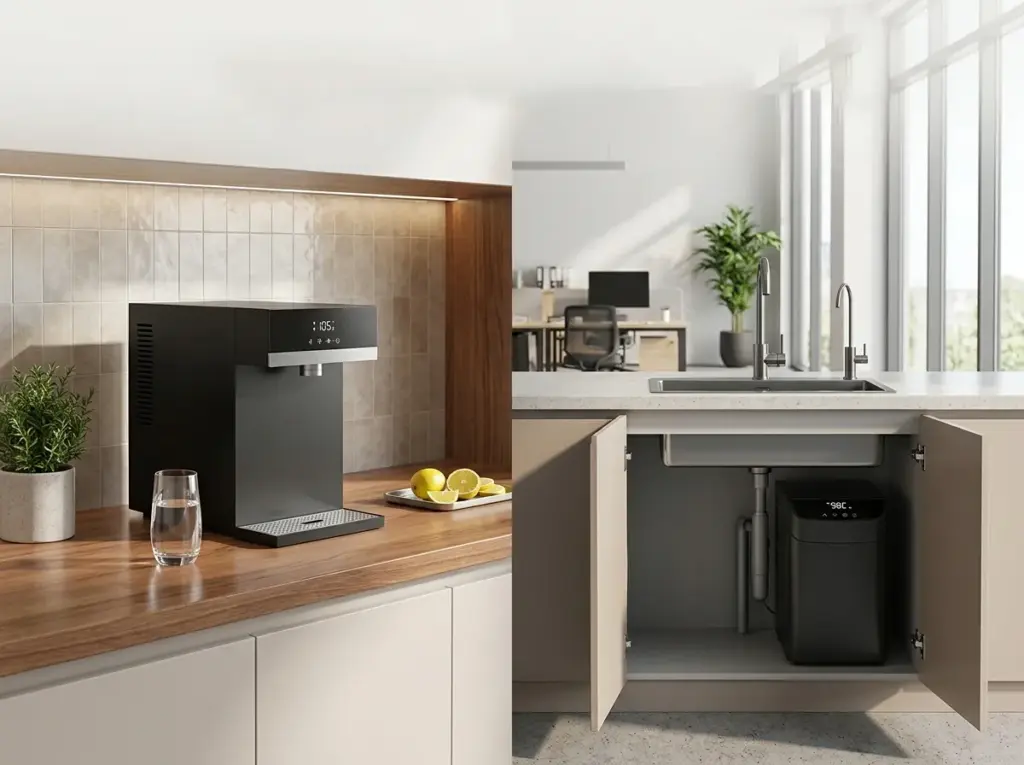
Floor-Standing
Floor-standing equipment is easy to access and works well when floor space is available.
It is a practical format for offices, waiting areas, public spaces, and other sites where the main unit can remain visible.
Countertop
A countertop system keeps the equipment above the work surface.
This can make inspection and service straightforward. It also works well when the site already has suitable counter space.
Under-Counter
An under-counter system moves the main equipment below the work surface.
This can free valuable counter space and create a cleaner finished layout. It becomes especially useful when one faucet needs to deliver several water functions.
For example, JNOD’s 6-in-1 under-sink water system combines multiple water functions in one integrated configuration.
The installation still needs planning.
Cabinet dimensions, utility connections, service access, and any equipment-specific clearance requirements should be confirmed before the cabinet is finished.
What Should a Distributor Compare?
For distributors, the first order is only part of the decision.
Look at the product range.
Can the supplier provide different water functions and installation formats? Can products be adapted for different voltage requirements, packaging, appearance, or target markets?
Then look at supply support.
Ask about spare parts, technical documentation, lead times, warranty terms, and repeat orders.
A product can work for one shipment.
A good supply program needs to work for the next shipment too.
What Should Builders Consider?
Builders usually focus on project integration.
The equipment has to fit the space and the building services.
Check the cabinet dimensions, faucet location, water connection, electrical supply, service clearance, and final appearance before the kitchen or pantry is completed.
A small change on the drawing is easy.
A change after installation is not.
What Should Installers Check?
Installers need the technical details behind the product.
Check the connection points and electrical data first. Then confirm water requirements, access to filters and service parts, and any ventilation or clearance specified by the manufacturer.
For sparkling systems, the CO₂ arrangement also matters.
Where is the cylinder located? Where is the regulator? Can the hose be routed cleanly? Can the technician reach everything later?
These questions are easy to overlook during installation.
They become much harder to solve after handover.
What About Filtration and Water Quality?
Filtration should be treated as its own specification.
A carbon-based filter may be certified for certain chlorine, taste, odor, or contaminant-reduction claims. Other systems may use reverse osmosis, UV treatment, water softening, or another technology for different water conditions.
NSF explains that different standards apply to different water-treatment functions. For example, NSF/ANSI 42 covers specific aesthetic-effect claims such as chlorine and taste/odor reduction, while NSF/ANSI 53 addresses specific health-effect contaminant reduction claims. Other standards cover technologies such as softeners, UV systems, and reverse osmosis. (NSF water treatment standards)
That distinction matters in commercial projects.
“Filtered water” is not a complete technical specification.
Ask what the filter is designed to reduce, its rated capacity and flow, its replacement interval, and whether the local water requires additional treatment.
Common Buying Mistakes
1. Choosing by the Product Name
A “water cooler” may be bottle-fed or directly connected.
A “water dispenser” may provide only chilled water or several functions.
Read the specification.
2. Assuming Bottleless Means Filtered
Bottleless describes the water source.
It does not describe the treatment method.
Those are different questions.
3. Comparing Only the Purchase Price
The initial price is only part of the cost.
Installation, filters, spare parts, service, and replacement cycles can affect the total operating cost.
4. Adding Functions That Will Rarely Be Used
A multifunctional system can be useful.
But if a project only needs chilled drinking water, adding several extra functions may create unnecessary cost and maintenance.
Specify what the site actually needs.
Which System Fits a Commercial Project?
It depends on the site.
A bottled cooler can make sense where permanent plumbing is unavailable or the installation is temporary.
A bottleless point-of-use system may suit a building with a suitable water connection and a preference for less bottle handling.
A countertop dispenser can work well when the equipment needs to remain visible and accessible.
An under-counter multifunctional system can be useful when several water functions have to fit into one compact installation.
There is no need to force every project into the same configuration.
Where Does JNOD Fit?
JNOD uses the broader water dispenser category because commercial projects often require different water functions and installation formats.
Our range covers chilled water, instant hot water, sparkling water, and multifunctional under-sink solutions.
We work with distributors, importers, builders, installers, kitchen brands, and other B2B customers.
Some projects need a standard configuration.
Others require a different voltage, appearance, packaging, function set, or product combination for a specific market. JNOD supports OEM and ODM water dispenser projects for these requirements.
For commercial buyers, that flexibility can be important.
The product needs to fit the project today and remain practical to supply and service later.
A Practical Way to Compare Water Equipment
When a customer asks, “Should I buy a water cooler or a water dispenser?”, start with six questions:
Where does the water come from?
Bottled or direct connection?
What water is required?
Chilled, hot, sparkling, ambient, or filtered?
What treatment is needed?
Carbon filtration, RO, softening, scale control, or another solution?
How will the equipment be installed?
Floor-standing, countertop, or under-counter?
What output is required?
Check rated output, flow rate, heating or cooling performance, and recovery.
How will it be maintained?
Make sure filters and key service components can be reached after installation.
Once these points are clear, the product name becomes much less important.
FAQ
What is the difference between a water cooler and a water dispenser?
The terms often overlap. “Water cooler” usually emphasizes chilled water, while “water dispenser” is commonly used more broadly for equipment that can provide chilled, hot, ambient, sparkling, or filtered water.
Can a water cooler be bottleless?
Yes. A water cooler can connect directly to a building water supply. “Bottleless” describes the water source, not the cooling function.
What is a bottleless water dispenser?
A bottleless water dispenser connects to a building water line and dispenses water at the point of use. Depending on the model, it may also include filtration, cooling, heating, or carbonation.
Is an under-counter water dispenser the same as a water cooler?
Not necessarily. An under-counter system may provide chilled water, but it can also provide hot, sparkling, and filtered water.
What should a business compare when choosing between a water cooler and water dispenser?
Compare the water source, water functions, treatment method, output, installation format, maintenance requirements, certifications, and supplier support. The product name alone is not enough.
Conclusion
The difference between a water cooler and a water dispenser is often less important than it first appears.
For a commercial project, start with the system itself.
Look at the water source. Define the water functions. Specify the treatment. Check the installation and service conditions.
Then choose the equipment.
That approach gives distributors, builders, and installers a clearer basis for comparing products and planning a system that fits the project.
At JNOD, we start from the same place.
Define the application first. Then choose the system.

 English
  Arabic
  Russian
  Spanish