
During lunch or dinner service, restaurant staff may need to fill several glasses or carafes within minutes, while the same equipment operates at a much lighter load between meal periods.
Choosing the right restaurant water dispenser capacity requires more than comparing hourly output ratings. The system must deliver enough chilled and sparkling water at the required temperature, without slowing down service during peak periods.
Quick answer: Estimate the busiest hour’s water demand, calculate chilled and sparkling requirements separately, and check dispensing speed, cooling capacity, and recovery performance. A dispenser’s rated L/h output is only useful when its test conditions match the intended application.
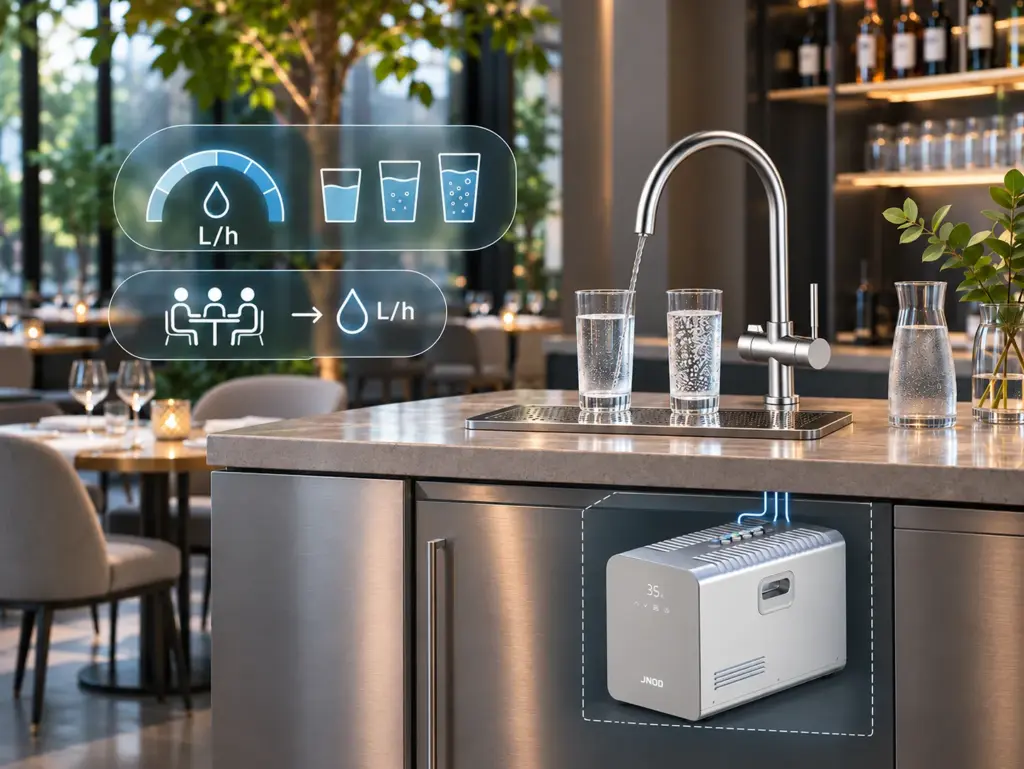
Start With Peak-Hour Water Demand
A restaurant serving 300 customers throughout the day may need less dispensing capacity than a smaller venue where most customers arrive during a concentrated lunch service.
The basic calculation is:
Peak demand (L/h) = Guests per peak hour × Average dispenser-supplied water per guest (L)
Use water actually supplied by the dispenser, including planned refills. Do not include bottled drinks, coffee, or other beverages prepared using separate equipment.
Where possible, estimate consumption from actual glass sizes, carafe refills, or service records. For a new project, the restaurant’s expected seating turnover and beverage-service model can provide a reasonable starting point.
Restaurant Sizing Example: 100 Guests Per Hour
Consider a restaurant with 100 guests during its busiest hour.
For this example, assume each guest receives an average of 0.30 L of dispenser-supplied water, with 60% of demand for chilled still water and 40% for sparkling water.
| Sizing Factor | Example Value |
|---|---|
| Guests during peak hour | 100 |
| Average water per guest | 0.30 L |
| Total peak demand | 30 L/h |
| Chilled water share | 60% |
| Sparkling water share | 40% |
| Chilled water requirement | 18 L/h |
| Sparkling water requirement | 12 L/h |
The calculation is:
Total: 100 × 0.30 = 30 L/h
Chilled water: 30 × 60% = 18 L/h
Sparkling water: 30 × 40% = 12 L/h
These are hypothetical figures, not industry-standard consumption rates.
A restaurant serving chilled water in large shared carafes may need considerably more. A bar selling sparkling water by the glass may have a different demand split.
For this example, the first equipment-selection requirement is clear: the system should be evaluated against 18 L/h chilled water and 12 L/h sparkling water, including any periods when both functions are needed simultaneously.
Cooling Capacity Is Not the Same as Dispensing Flow Rate
Cooling capacity, usually expressed in L/h, describes how much water the system can cool to a specified temperature under defined test conditions.
Dispensing flow rate, expressed in L/min, describes how quickly water flows from the outlet.
A unit may fill glasses rapidly using water stored in a chilled reservoir. However, the refrigeration system still needs time to cool replacement water.
A fast-flowing tap does not automatically mean high continuous cooling capacity.
A Short-Burst Dispensing Example
Suppose restaurant staff need to fill eight 250 mL glasses within two minutes.
The required average dispensing flow is:
8 × 0.25 L ÷ 2 min = 1 L/min
This does not mean the refrigeration system must continuously produce 60 L/h of chilled water.
In practice, tap operation, switching between water types, and glass handling also take time. The required outlet flow may therefore need to be higher than the calculated minimum.
For busy restaurants, ask the supplier about consecutive dispensing performance and the time needed to recover after repeated draws.
How Inlet Water Temperature Affects Cooling Capacity
Cooling water from 25°C to 5°C requires more energy than cooling the same volume from 15°C to 5°C.
The approximate thermal cooling load can be calculated using:
Cooling load (kW) = Water flow (L/h) × 4.18 × Temperature difference (°C) ÷ 3,600
The calculation treats one liter of water as approximately one kilogram and uses a specific heat capacity of about 4.18 kJ/(kg·°C). NIST provides reference data for the thermal properties of water.
For the example restaurant, assume all 30 L/h of chilled and sparkling water enters at 25°C and is delivered at 5°C.
30 × 4.18 × (25 − 5) ÷ 3,600 ≈ 0.70 kW
The result is approximately 0.70 kW of useful thermal cooling load.
It is not the dispenser’s electrical power consumption, compressor rating, or complete refrigeration-system capacity requirement. It excludes heat gains, equipment losses, and other design considerations.
Sparkling water temperature also affects carbonation performance, so the required delivery temperature should be confirmed for both water types.
When comparing suppliers, request the inlet temperature, outlet temperature, ambient temperature, and operating conditions associated with the published cooling-capacity rating.
How to Evaluate a 60 L/h Chilled and Sparkling Water System
JNOD’s commercial sparkling and chilled water core module is described with separate output ratings of:
- 60 L/h chilled water
- 60 L/h sparkling water
The product is also presented as supporting simultaneous chilled and sparkling water supply, with integrated and embedded configurations for commercial applications.
For our restaurant example, the estimated demands of 18 L/h chilled water and 12 L/h sparkling water are below these separately published ratings.
The manufacturer must confirm the rated performance under the required inlet water temperature, outlet temperature, ambient conditions, and dispensing pattern.
Do not assume that two separate 60 L/h ratings guarantee 120 L/h of sustained simultaneous output.
If the two functions share refrigeration components, their combined operating performance needs to be verified.
JNOD’s Commercial Sparkling Water Dispenser Buying Guide provides a broader comparison of commercial equipment configurations.
Allow for Real Service Conditions
A restaurant averaging 30 L/h during its busiest hour may experience a much higher draw during a short interval when multiple tables request water at once.
Demand can also change with seasonal temperatures, menu choices, seating turnover, and future expansion.
Instead of applying an arbitrary safety margin, consider the most demanding realistic service period.
Ask whether the equipment can supply consecutive glasses or carafes without an unacceptable rise in water temperature or loss of carbonation quality.
The number and location of dispensing points also matter. A single high-output station may have sufficient cooling capacity but still create delays when staff from several service areas use the same tap.
For larger venues, several appropriately positioned dispensing points may be more practical than one centralized outlet.
Check the Installation Conditions
Air-cooled refrigeration units need sufficient ventilation to reject heat. Restricted cabinet airflow can affect cooling performance, particularly in warm commercial kitchens.
Water pressure and flow must remain adequate when other equipment operates. Filtration, pipe routing, and fittings can also influence dispensing performance.
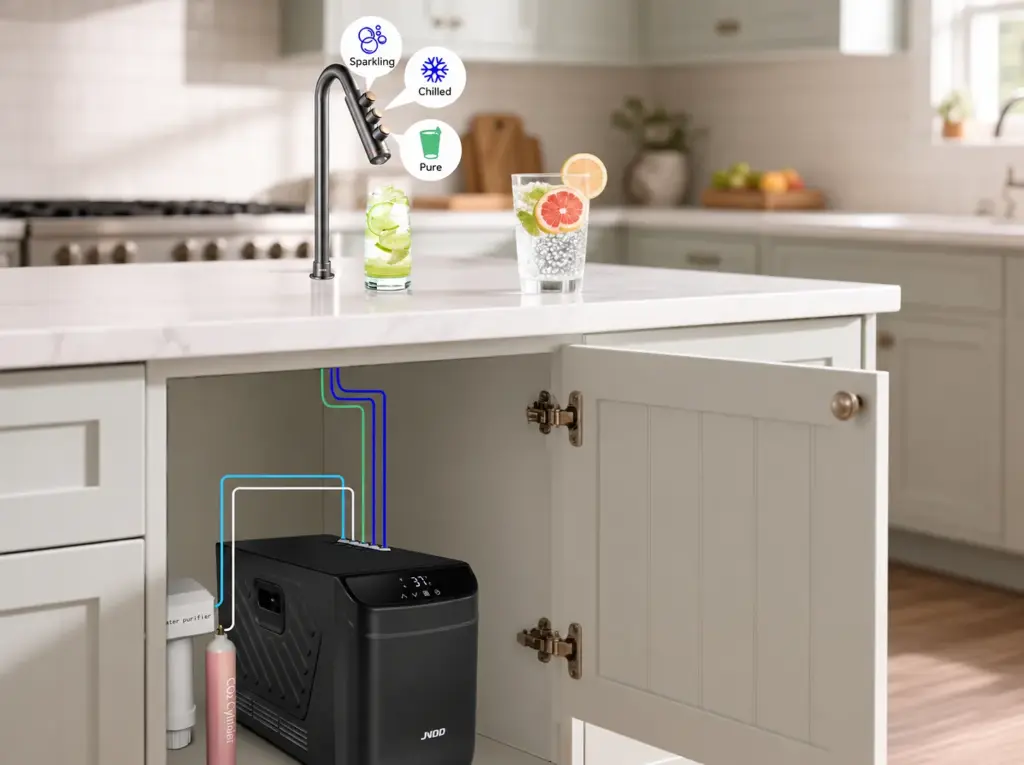
Sparkling systems require a suitable CO₂ supply and a safe cylinder installation.
Before approving a model, confirm its electrical requirements, physical dimensions, ventilation arrangement, maintenance access, and any installation restrictions.
JNOD’s restaurant water dispenser solutions show how chilled, sparkling, and other dispensing functions can be incorporated into commercial food-service environments.
What Should Restaurant Buyers Request From the Manufacturer?
Provide the expected guests per peak hour, estimated chilled and sparkling demand, target dispensing temperature, and typical glass or carafe size.
Also describe any short periods of concentrated demand and whether both water functions need to operate simultaneously.
The manufacturer should then be able to clarify the relevant capacity ratings, dispensing flow, recovery performance, and test conditions.
For distributors and OEM/ODM customers, the same information helps determine whether an integrated system, embedded core module, or customized beverage station is appropriate.
Final Thoughts
Calculate chilled and sparkling water requirements separately, then compare them with verified equipment data.
For commercial projects, contact JNOD with your expected demand and installation conditions to discuss suitable water dispensing configurations.
 English
 Arabic
 Russian
 Spanish