
For offices, restaurants and commercial beverage stations, CO₂ cylinder consumption affects refill schedules, operating costs and the continuity of sparkling water service.
At JNOD, we manufacture chilled and sparkling water dispensing systems for commercial and residential applications. Beyond refrigeration and dispensing capacity, gas consumption is an important part of system planning.
إجابة سريعة: Using two illustrative CO₂ consumption rates, a 2 kg cylinder can theoretically produce approximately 400 L of sparkling water at 5 g/L or 286 L at 7 g/L. For a business dispensing 20 L of sparkling water daily, that represents about 14–20 operating days.
These consumption rates are calculation assumptions, not JNOD’s measured or guaranteed equipment performance.
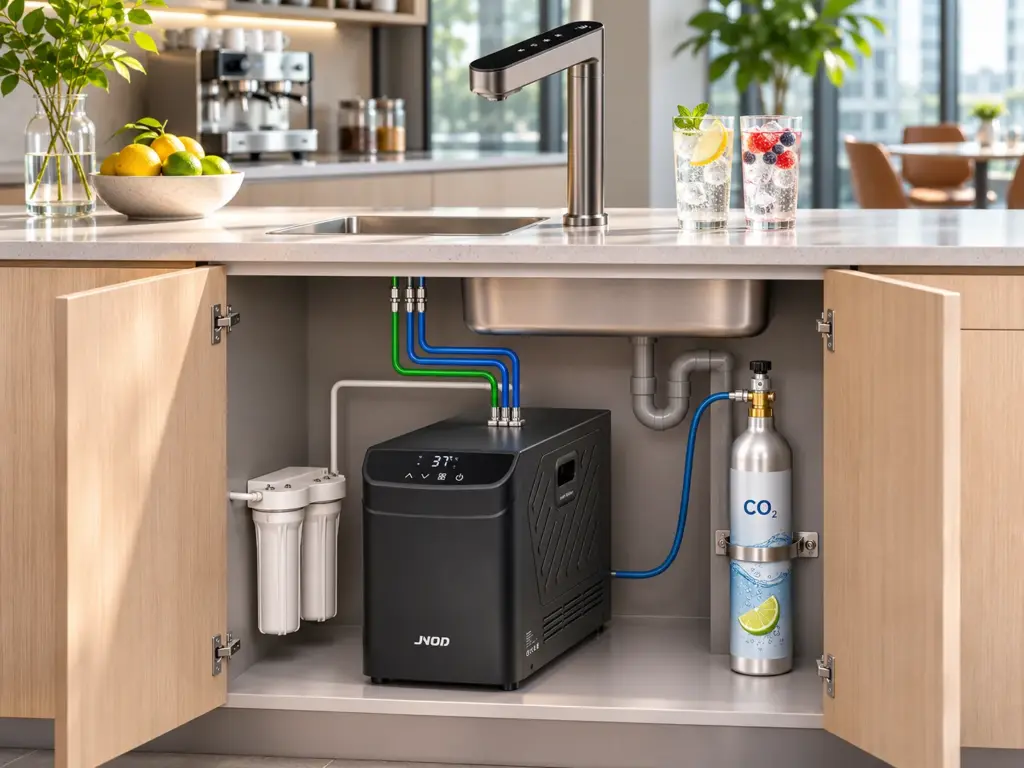
How Much CO₂ Does a Sparkling Water Dispenser Use?
A sparkling water dispenser introduces pressurized, food-grade CO₂ into drinking water. The gas dissolves during carbonation and forms bubbles when the water is dispensed.
For cylinder planning, CO₂ consumption is expressed in grams of gas used per liter of sparkling water (g/L).
This figure includes the gas drawn from the cylinder, which may be greater than the amount remaining dissolved in the finished water.
The theoretical output is calculated as:
Theoretical sparkling water output (L) = Cylinder net CO₂ fill (g) ÷ CO₂ consumption (g/L)
For a 2 kg cylinder containing 2,000 g of CO₂:
At 5 g/L:
2,000 ÷ 5 = 400 L
At 7 g/L:
2,000 ÷ 7 ≈ 286 L
The higher consumption scenario produces approximately 29% less sparkling water from the same cylinder.
The formula uses the cylinder’s nominal net gas fill. Real-world output also reflects residual gas and operating losses.
How Long Will Different CO₂ Cylinder Sizes Last?
Cylinder size determines the available gas supply, while daily sparkling water demand determines the replacement interval.
The following examples compare three cylinder fill sizes using the same two assumed consumption rates.
| CO₂ Net Fill | Output at 5 g/L | Output at 7 g/L |
|---|---|---|
| 425 g | 85 L | 61 L |
| 2 kg | 400 L | 286 L |
| 5 kg | 1,000 L | 714 L |
For an installation dispensing 20 L of sparkling water per day, a 2 kg cylinder provides:
- 20 operating days at 5 g/L
- 14.3 operating days at 7 g/L
These calculations offer a practical starting point for estimating how frequently a business will need fresh CO₂ supplies.
The cylinder’s net fill weight is the figure used in the calculation. Its physical capacity in liters describes the cylinder’s internal volume, not the mass of CO₂ available for carbonation.
For larger commercial installations, the replacement schedule also needs to account for the gas supplier’s delivery or exchange arrangements.
Commercial Example: CO₂ Supply for an Office
Consider an office installing an under-counter chilled and sparkling water dispenser.
Employees and visitors consume approximately 50 L of dispenser-supplied drinking water each working day:
- 30 L of chilled still water
- 20 L of sparkling water
Only sparkling water requires carbonation gas.
Daily CO₂ Consumption
At 5 g/L:
20 L × 5 g/L = 100 g CO₂/day
At 7 g/L:
20 L × 7 g/L = 140 g CO₂/day
Cylinder Replacement Interval
Using a 2 kg CO₂ cylinder:
2,000 g ÷ 100 g/day = 20 operating days
2,000 g ÷ 140 g/day ≈ 14.3 operating days
For a five-day working week, the estimated cylinder life is approximately 2.9–4 working weeks.
This gives the office a basis for planning CO₂ deliveries and replacement stock.
Equipment Capacity Still Matters
Increasing cylinder size extends the available gas supply, but it does not increase the refrigeration or carbonation capacity of the dispenser.
A system serving multiple users within a short period needs sufficient chilled-water production, carbonation performance and dispensing flow.
For projects with concentrated demand, our restaurant water dispenser sizing guide explains how to calculate peak-hour water requirements and evaluate equipment output.
At JNOD, we evaluate gas supply alongside the dispenser’s cooling and dispensing performance. A well-matched system delivers the required water functions without creating unnecessary service interruptions.
What Affects CO₂ Consumption?
CO₂ use is influenced by the water entering the carbonation system, the desired sparkling-water characteristics and the efficiency of gas transfer.
Water Temperature
Water temperature has a direct effect on carbonation.
At the same pressure, colder water can hold more dissolved CO₂ than warmer water. The relationship is described in the University of Florida’s carbonation guide.
JNOD’s under-counter sparkling water dispenser range includes models with adjustable chilled-water temperatures from 3°C to 15°C.
This gives users flexibility over the chilled-water setting while the refrigeration system provides the cooling required for the selected configuration.
For a sparkling water installation, cooling performance and carbonation performance are closely connected. Water that enters the carbonation process at an appropriate temperature supports more effective CO₂ dissolution.
Carbonation Level
The desired carbonation level influences how much CO₂ is required.
Stronger carbonation generally means a higher concentration of dissolved gas in the finished water.
The cylinder supplies that gas, while the equipment’s carbonation process determines how efficiently it is transferred into the water.
As a result, CO₂ consumption is influenced by both the selected carbonation level and the system’s gas management.
For commercial installations, these operating characteristics are more useful than comparing carbonation pressure alone.
Gas Losses and Equipment Condition
Not all gas drawn from a cylinder remains dissolved in the dispensed water.
Some CO₂ may be released during normal operation, while leaks or poorly maintained connections can increase consumption.
A simple operating record helps identify changes.
By tracking the date of each cylinder replacement and the volume of sparkling water produced, operators can observe whether gas consumption remains consistent.
A sudden reduction in cylinder life without an increase in water demand is a useful indication that the gas supply system needs attention.
How to Calculate CO₂ Cost per Liter
For commercial buyers, cylinder usage becomes more meaningful when converted into the cost of producing sparkling water.
الحساب هو:
CO₂ cost per liter = CO₂ refill cost ÷ Sparkling water output
Suppose a 2 kg CO₂ refill costs $20.
| Cost Calculation | At 5 g/L | At 7 g/L |
|---|---|---|
| Theoretical output | 400 L | 286 L |
| Example refill cost | $20 | $20 |
| CO₂ cost per liter | $0.05 | $0.07 |
The $20 refill price is an illustrative value rather than a JNOD quotation.
Under these assumptions, the CO₂ cost is approximately 5–7 US cents per liter.
Monthly Operating Cost Example
For a business dispensing 600 L of sparkling water per month:
At 5 g/L:
600 L × 5 g/L = 3 kg CO₂
At 7 g/L:
600 L × 7 g/L = 4.2 kg CO₂
Using an assumed gas cost of $10/kg:
Estimated monthly CO₂ consumption cost = $30–$42
Cylinder invoices may follow different refill or exchange quantities, while this calculation represents the value of the gas consumed.
The complete cost of sparkling water also includes water supply, filtration, electricity, equipment, maintenance and any gas delivery or cylinder rental charges.
Separating CO₂ costs from other expenses makes it easier to compare operating models and estimate long-term project expenses.
Planning CO₂ Cylinder Replacement
A consistent replacement schedule is particularly important for offices, restaurants and hospitality facilities where sparkling water is available throughout the day.
The basic planning formula is:
Daily CO₂ demand (g/day) = Daily sparkling water volume (L) × CO₂ consumption (g/L)
Once an installation is operating, actual gas usage records provide a more accurate basis for future purchases.
Measured CO₂ consumption (g/L) = CO₂ mass used (g) ÷ Sparkling water dispensed (L)
For example, if a system uses 1.5 kg of CO₂ to dispense 300 L of sparkling water:
1,500 g ÷ 300 L = 5 g/L
This measured value reflects the gas used by the installation, including operating losses.
Cylinder mass records are more informative than pressure readings when estimating the remaining CO₂ supply. Because CO₂ is stored partly as a liquid, cylinder pressure does not reliably indicate how much gas remains. Air Liquide’s CO₂ cylinder guidance explains this characteristic.
Gas measurements and cylinder handling should use appropriate equipment and approved procedures.
A reliable supply arrangement combines predictable cylinder consumption with convenient access to replacement cylinders.
CO₂ Cylinder Compatibility and Safety
Commercial sparkling water systems require a suitable food-grade CO₂ supply, compatible cylinder connections and a correctly specified pressure regulator.
Cylinder selection also influences installation space, replacement access and the local gas supply arrangements.
CO₂ can accumulate in poorly ventilated areas and create a serious asphyxiation hazard. Appropriate ventilation, secure cylinder storage and a site-specific safety assessment are essential. Gas detection or other safeguards may be required by the installation conditions and applicable regulations.
إن British Compressed Gases Association’s beverage dispense gas guidance provides industry information on beverage gases, cylinder handling and safe installation.
The cylinder supply method also matters. Systems designed for gaseous CO₂ withdrawal require the appropriate cylinder and regulator arrangement rather than a liquid-withdrawal setup.
Integrating the gas supply into the equipment layout from the beginning helps maintain convenient servicing and a safe working environment.
CO₂ Supply Planning for Distributors and OEM/ODM Projects
For distributors and project buyers, CO₂ supply planning is part of the complete sparkling water system specification.
At JNOD, we focus on four practical considerations:
Water demand and equipment performance: Daily sparkling water volume, peak dispensing requirements, cooling capacity and carbonation output.
Gas supply configuration: Food-grade CO₂ availability, suitable cylinder connections, regulator compatibility and local refill arrangements.
Installation integration: Equipment dimensions, refrigeration ventilation, cylinder placement and access for service work.
Operating economics: Expected gas consumption, refill costs, component maintenance and replacement availability.
These factors support more accurate equipment selection and operating-cost estimates.
For OEM/ODM projects, the faucet, refrigeration unit, carbonation components and gas supply connections form part of the overall system design. Their compatibility influences installation efficiency and long-term serviceability.
Through our OEM/ODM services, we work with distributors and brand partners on water dispensing configurations for different applications and markets.
الأفكار النهائية
You can estimate a CO₂ cylinder’s service life from its net gas content and the dispenser’s gas consumption per liter. The calculation also provides a practical basis for planning replacement intervals and operating costs.
At JNOD, we combine dispensing performance with refrigeration and carbonation requirements to help our partners select suitable chilled- and sparkling-water systems.
للتواصل مع JNOD to discuss your project’s sparkling water demand and system configuration.
 English
 Arabic
 Russian
 Spanish