
Choosing a water dispenser manufacturer involves more than comparing product appearance and unit price.
For distributors, importers, appliance brands and project buyers, many of the most important questions are behind the finished product. Who controls production? How is each unit tested? Will the mass-produced version match the approved sample? Can the supplier support the electrical, compliance and documentation requirements of your market?
A reliable manufacturer should answer these questions with clear technical information, production records, and verifiable documentation—not just a sales presentation.
If you are still deciding which type of equipment fits your project, JNOD’s Commercial Water Dispenser Buying Guide explains the main considerations for hot, chilled, sparkling, filtered, countertop and under-counter systems.
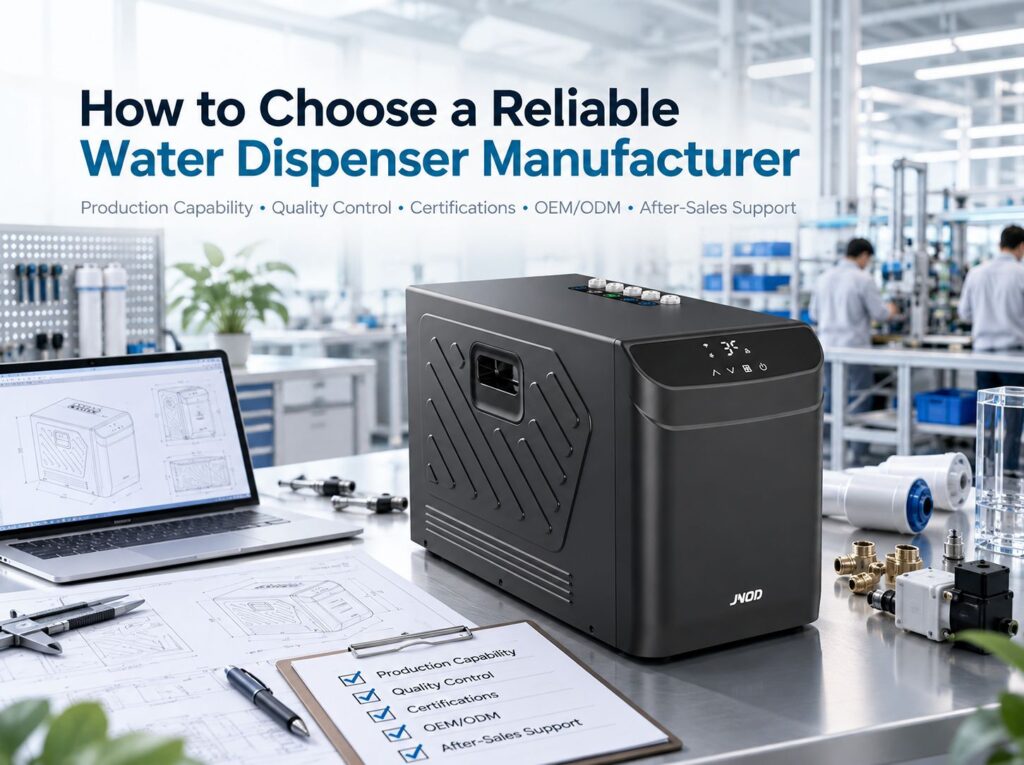
Start With the Manufacturer’s Real Production Capability
A professional website does not necessarily show how much control a supplier has over the product it sells.
Before discussing a large order, understand where the equipment is assembled, which operations the factory handles, and how it inspects incoming components. Water dispensers can involve heating systems, refrigeration, pumps, valves, water tanks, tubing, control boards, filtration components and final electrical assembly.
Using specialized component suppliers is normal. Compressors, pumps, valves and filters are often sourced from companies that focus on those technologies.
What matters is how the manufacturer controls incoming materials, assembly, testing and changes to approved components.
Factory size is useful information, but it should be considered together with production processes and quality control. JNOD currently lists an 8,000 m² manufacturing facility, six production lines and more than 60 testing devices on its factory and testing facilities page.
For larger sourcing programs, a factory visit can help verify what you have already learned from specifications, samples and video calls. Instead of treating it as a showroom tour, look at active production, incoming-material control, testing stations, engineering resources and how a product moves from assembly to final inspection.
Look Beyond the Product Sample
A good sample is important, but one successful unit does not prove that later production will remain identical.
A pump, heater, PCB, valve, filter or tubing material can change between sample approval and mass production if component control is weak. The finished product may look the same while its performance or service requirements have changed.
Ask how the factory records the approved specification and how substitutions are controlled. It should also be clear how units are checked for leakage, electrical safety, heating or cooling performance, appearance and final operation before shipment.
For business purchasing, sample-to-production consistency is often more important than the quality of the first sample alone.
A quality management system can support this process, but it should not be confused with product approval. ISO describes ISO 9001 as a standard for establishing and maintaining a quality management system rather than certification of a specific appliance. ISO
Make Sure the Manufacturer Understands the Product Category
Not every water appliance factory works with the same technologies.
A supplier that mainly produces basic ambient-water coolers may not have the same engineering experience as a manufacturer working with instant hot water, refrigeration, carbonation, filtration and multifunctional under-counter systems.
A factory that regularly develops instant hot water dispensers, chilled systems, sparkling water chillers, multifunctional taps and under-counter drinking-water systems already has to manage several technical disciplines inside the same product range.
That experience becomes more important as product complexity increases. A system combining heating or refrigeration with pumps, electronic controls and water-contact components creates different engineering and testing requirements from a basic dispenser.
When comparing suppliers, look for experience with the type of product you actually plan to buy, not simply the number of products shown in the catalogue.
Verify Certifications by Exact Model
Asking a supplier, “Do you have CE, NSF, WRAS or ETL?” is not enough.
Certifications, approvals and declarations normally apply within a defined scope. A supplier may have compliant products in one range without every model in its catalogue being covered by the same documentation.
The model number on the document should correspond with the product being quoted. Buyers also need to understand what was assessed: the complete appliance, a product family, a filter, a water-contact material or an individual component.
Customized products deserve additional attention. Changing electrical components, filtration systems, tubing materials or internal construction can affect existing compliance documentation.
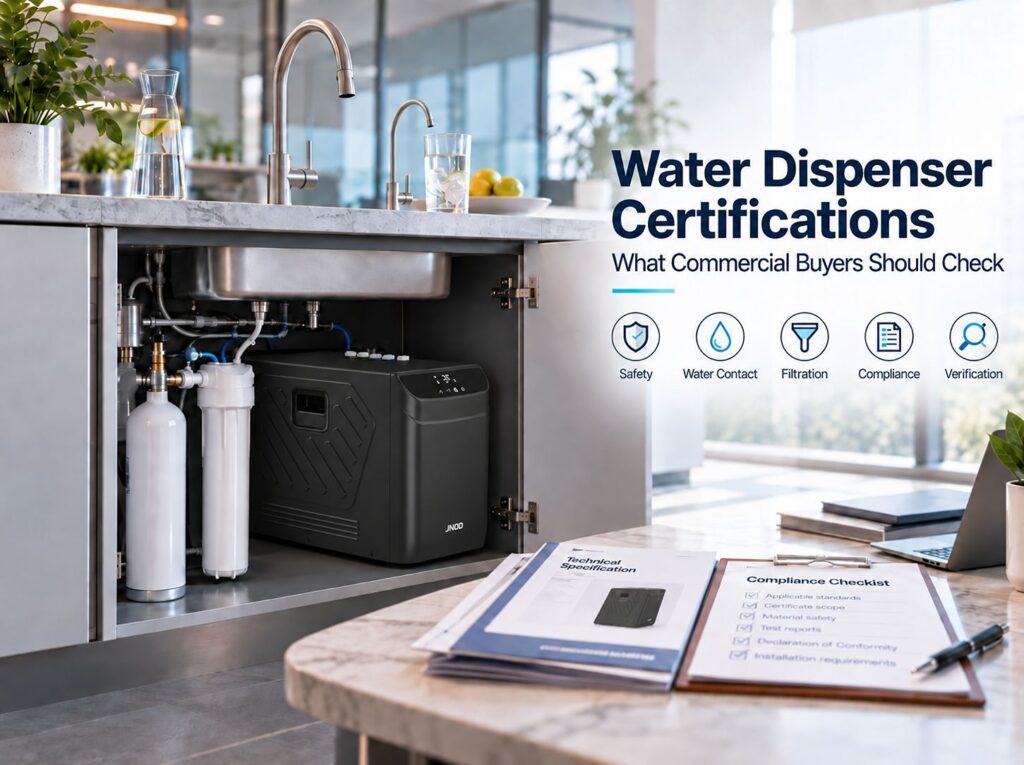
JNOD’s separate guide to water dispenser certifications and standards explains how buyers can review certification scope, model numbers and supporting documents in more detail.
For products within the scope of EU legislation requiring CE marking, the European Commission states that manufacturers are responsible for identifying the applicable requirements, carrying out conformity assessment, preparing technical documentation and issuing the EU Declaration of Conformity. Internal Market Canada
OEM and ODM Capability Should Mean More Than Branding
Changing a logo and carton can be enough for a simple private-label project.
It is not the same as developing a customized product.
More advanced OEM or ODM projects may involve the product housing, faucet, user interface, functions, temperature settings, voltage, filtration system, accessories or internal structure. Each change can affect engineering effort, tooling, testing, cost and lead time.
A useful discussion with the manufacturer is not simply “Can you customize this?”
Ask which changes can be made within the existing platform and which require engineering validation or new compliance work.
JNOD’s OEM and ODM water dispenser service covers customization of product appearance, functions, structure, accessories, packaging and related project requirements.
For buyers planning a private-label range, this distinction helps separate basic branding capability from genuine product-development support.
Technical Communication Is Part of Supplier Evaluation
Many sourcing problems begin before production because important operating conditions were never defined.
“Cold water,” for example, does not specify the target outlet temperature. Required output means little without considering inlet-water temperature and demand. An under-counter system may physically fit inside a cabinet but still lack enough space for ventilation or servicing.
Before approving a project, the manufacturer should be able to discuss target voltage and frequency, water pressure, temperature requirements, output, installation space, filtration, ventilation, drainage and market-specific compliance requirements where applicable.
The quality of these discussions tells you something about the supplier.
A manufacturer that identifies missing technical information before production can prevent problems that would be much more expensive to correct later.
Lead time should be discussed in the same way. A number such as “30 days” has limited value unless both sides know when the clock starts and what is included.
A standard repeat order may move directly into component preparation and assembly. An OEM project can require sample confirmation, engineering review, packaging approval, component preparation, pilot production and testing before mass production begins.
For large programs, realistic planning is more useful than the shortest promise.
After-Sales Support and Spare Parts Matter
The relationship with a water dispenser manufacturer does not end when the container leaves the factory.
Distributors and service partners may later need filters, faucets, pumps, valves, control boards, heating parts, refrigeration components or troubleshooting information.
Before placing a significant order, understand how spare parts are identified, supplied and documented. For more complex products, ask whether wiring information, fault codes, exploded views or replacement guidance can be provided where appropriate.
This becomes particularly relevant for systems that combine several functions. A boiling, chilled and sparkling water system has more service points than a simple ambient-water dispenser.
A slightly lower purchase price can lose its advantage quickly if a distributor cannot obtain a replacement component or diagnose a field problem.
A Quick Supplier Check Before You Shortlist
| What to Check | Why It Matters | What to Ask For |
|---|---|---|
| Manufacturing control | Shows how much control the supplier has over production | Factory information, production process, testing setup |
| Sample-to-production consistency | Reduces the risk of component changes after sample approval | Approved BOM/specification and change-control process |
| Certification scope | Confirms documents apply to the actual model | Model number, certificates, declarations and test scope |
| OEM/ODM capability | Separates simple branding from engineering customization | Customization options and validation requirements |
| After-sales support | Affects long-term distributor service | Spare-parts list, technical documents and service support |
Final Thoughts
Choosing a reliable water dispenser manufacturer requires more than finding a product with the right appearance and price.
For long-term Business cooperation, production control, technical communication, sample-to-production consistency, compliance support and after-sales capability can matter just as much as the initial specification.
OEM and ODM projects benefit from evaluating these factors early. Questions about components, certification, installation and production are much easier to resolve during product development than after mass production has started.
A good manufacturer should make the sourcing process easier to verify, not harder.

 English
  Arabic
  Russian
  Spanish