
Water dispenser certifications can affect whether a product is suitable for sale, installation, or distribution in a target market. For commercial buyers, however, checking compliance involves more than looking for certification logos on a brochure.
A CE mark, an NSF-certified filter, and a WRAS-approved component do not prove the same thing. The applicable requirements depend on the market, product design, water treatment technology, electrical system, and materials in contact with drinking water.
For distributors, importers, project buyers, and OEM customers, the practical question is not “How many certifications does this product have?” It is:
Do the documents cover the exact product and market I am buying for?
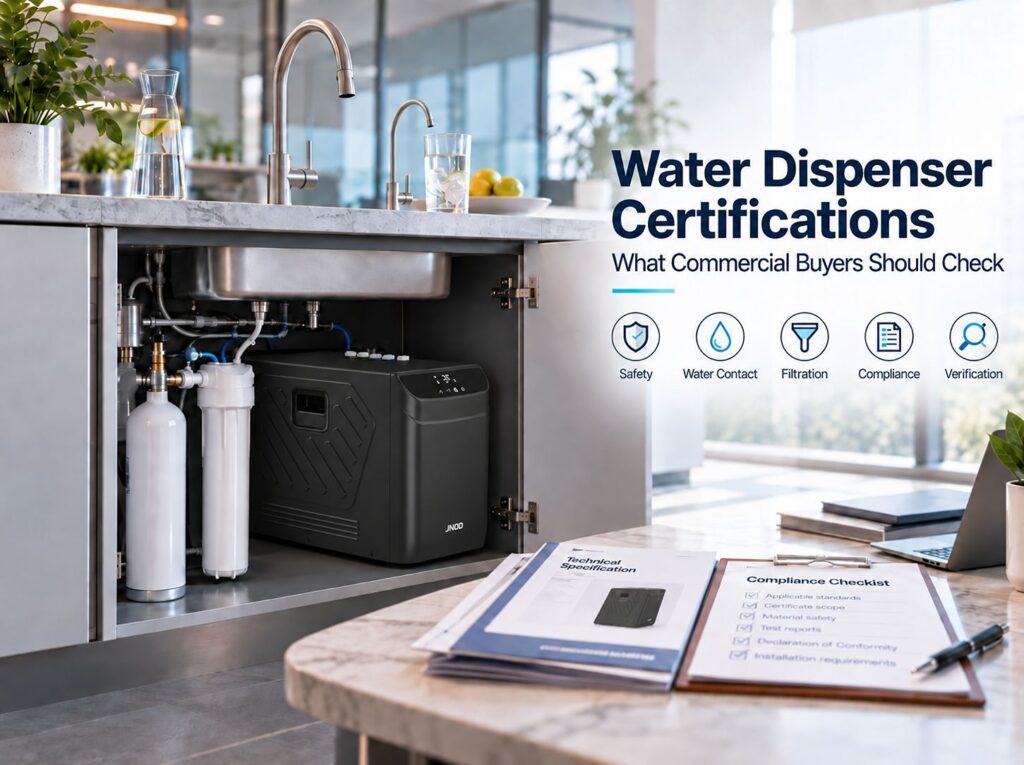
Which Water Dispenser Certifications Should Buyers Check?
There is no universal certification package for every commercial water dispenser.
An electrically powered chilled water dispenser has different compliance considerations from an RO system. A multifunctional unit providing boiling, chilled, and sparkling water may involve several electrical and water-contact requirements.
The table below gives buyers a practical starting point.
| Certification / Standard | Main Area | Where It May Be Relevant |
|---|---|---|
| CE marking | Conformity with applicable EU harmonisation legislation | Products within the scope of relevant EU rules |
| LVD | Electrical safety | Electrical equipment within its scope |
| EMC | Electromagnetic compatibility | Electrical and electronic equipment |
| RoHS | Restricted hazardous substances | Electrical and electronic equipment |
| NSF/ANSI 42 | Aesthetic filtration claims | Drinking-water filtration |
| NSF/ANSI 53 | Health-effect contaminant reduction | Drinking-water filtration |
| NSF/ANSI 58 | Reverse osmosis systems | RO drinking-water systems |
| NSF/ANSI/CAN 61 | Health effects of drinking-water contact | Materials, components, and systems within scope |
| WRAS | Water fittings and materials approval | Relevant UK water installations |
| UL / ETL | Product safety certification or listing | North American markets |
| ISO 9001 | Quality management system | Manufacturer assessment |
Treat this as a reference, not a universal compliance checklist. Requirements should always be confirmed for the exact product and destination market.
CE Marking: What EU Buyers Should Actually Check
CE marking is often described simply as a “certification,” but that can be misleading.
For products covered by applicable EU harmonisation legislation, the manufacturer is responsible for identifying the relevant requirements, completing the required conformity assessment, preparing technical documentation, issuing an EU Declaration of Conformity, and affixing the CE mark.
For an electrical water dispenser, applicable legislation may address electrical safety, electromagnetic compatibility, restricted substances, or other areas depending on the product.
This means a buyer should not stop after seeing a CE logo.
For an EU project, ask for the EU Declaration of Conformity and check whether the model number matches the product being ordered. The document should identify the manufacturer and the applicable legislation and standards.
The European Commission provides further guidance on CE marking and manufacturer responsibilities.
LVD, EMC and RoHS Cover Different Areas
These terms often appear together in water dispenser specifications, but they address different issues.
The Low Voltage Directive concerns electrical safety for equipment within its defined scope and voltage ranges. In a powered dispenser, relevant components may include heating elements, compressors, pumps, wiring, control boards, and protective devices.
EMC concerns electromagnetic disturbance and the equipment’s ability to operate correctly in its intended electromagnetic environment.
RoHS restricts specified hazardous substances in electrical and electronic equipment.
A multifunctional dispenser can combine heaters, chillers, pumps, control boards, and water circuits inside one enclosure. Buyers should therefore review the compliance documents applicable to the finished product rather than assume that one test or document covers every requirement.
NSF Standards: Read the Number, Not Just the Logo
“NSF certified” by itself does not tell a buyer exactly what has been evaluated.
Different NSF/ANSI standards address different technologies and performance claims.
NSF/ANSI 42 covers specific aesthetic effects, including claims related to chlorine, taste, and odor reduction.
NSF/ANSI 53 covers specific contaminant-reduction claims associated with health effects.
NSF/ANSI 58 applies to reverse osmosis drinking-water treatment systems.
NSF/ANSI/CAN 61 addresses health effects associated with materials, components, and products that contact drinking water.
NSF explains the differences between these standards in its official water treatment standards guide.
This distinction matters when evaluating a dispenser with an integrated filtration system. A filter certified to a particular NSF/ANSI standard supports the claims covered by that certification. It does not automatically extend the same certification to every tank, tube, valve, fitting, faucet, or other component in the complete dispenser.
For procurement, check what was certified, which standard applies, and what claims are covered.
What Does WRAS Approval Mean?
WRAS approvals are particularly relevant when checking whether water fittings and materials comply with applicable UK water fittings requirements.
Buyers should distinguish between WRAS Product Approval and WRAS Material Approval.
A Product Approval applies to the products and models listed in the approval documentation. A Material Approval applies to the specified non-metallic material or component.
This distinction is particularly important in OEM and private-label sourcing. A similar product or a rebranded version should not be assumed to fall under an existing approval unless it is included within the documented scope.
Commercial buyers can verify current information through the WRAS Product Approvals directory.
The practical lesson is simple: check the approval number, exact model, scope, and any applicable conditions rather than relying on a WRAS logo alone.
UL and ETL for North American Projects
For products intended for the United States and Canada, buyers often encounter UL or ETL marks associated with product safety.
The important procurement question is not which logo looks more familiar. What matters is whether the exact product is certified or listed to the appropriate standard for the intended market.
Check the model covered by the certification, the applicable standard, and whether the configuration being purchased matches the evaluated product.
This deserves extra attention in OEM projects. A change to an electrical component, heater, pump, control board, or other part may affect the certification status of the finished product.
ISO 9001 Is Useful, but It Is Not Product Certification
ISO 9001 can help buyers assess how a manufacturer manages quality processes. It does not prove that a specific water dispenser meets the electrical, filtration, or drinking-water requirements of a particular market.
In other words, a quality management system certification and a product certification answer different questions.
This is also why supplier assessment should look beyond certificates alone. JNOD operates an 8,000 m² manufacturing facility with six production lines and more than 60 testing devices. Buyers who want to assess production and quality-control capability can review our water dispenser factory and testing facilities.
How Commercial Buyers Can Verify Certification Claims
A certificate PDF should not automatically end the compliance review.
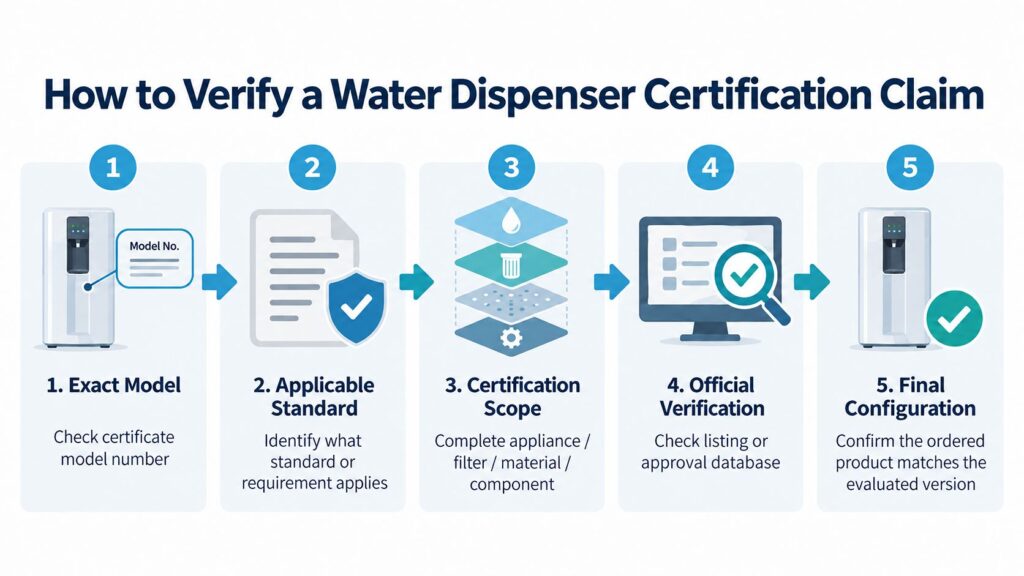
Start by matching the model number on the document with the product on the quotation or purchase order. Then check the referenced standard and, more importantly, the scope: does it cover the complete appliance, a product family, a filter, a material, or only one component?
If the certification or approval body maintains a public database, verify the certificate or listing number there.
For customized products, compare the certified configuration with the version you will actually receive. Changes to electrical parts, water-contact materials, filtration components, or product construction may affect the existing compliance documentation.
This is particularly important for importers buying private-label or customized equipment.
What Documents Should a Commercial Buyer Request?
The exact document package varies by product and market, but buyers should be able to obtain and review the compliance information relevant to the equipment they plan to purchase.
Depending on the project, this may include:
- applicable certificates or approvals;
- an EU Declaration of Conformity where required;
- relevant test reports;
- model lists or documented certification scope;
- drinking-water contact or filtration documentation;
- installation and user manuals;
- manufacturer and product traceability information.
The objective is not to collect paperwork for its own sake.
A test report, certificate, approval, and Declaration of Conformity serve different purposes. The useful question is whether the available documentation supports the compliance claim being made for the actual product.
OEM Water Dispensers Need Earlier Compliance Planning
Certification becomes more complicated when a standard product is customized.
Changing a logo or carton is very different from changing a heater, power supply, filter, tubing material, faucet, pump, compressor, or control system. Technical changes may affect existing documentation or require additional assessment.
For that reason, the destination market and compliance requirements should be discussed while the product configuration is being finalized.
At JNOD, our OEM and ODM water dispenser service includes customization of appearance, functions, structure, accessories, packaging, and documentation. For OEM projects, compliance considerations can be reviewed alongside these product decisions rather than after the design is complete.
This matters particularly with multifunctional equipment. A countertop sparkling and chilled water dispenser combines cooling, carbonation, electronic controls, and water-contact components in one system.
Heating products introduce another set of design considerations. When sourcing an instant hot water dispenser, buyers should review the documentation relevant to the actual electrical and water-contact configuration being supplied.
Common Certification Mistakes in Water Dispenser Sourcing
Most certification problems are not caused by buyers ignoring compliance completely. They usually come from misunderstanding what a document actually covers.
A certificate may belong to a similar model rather than the product being purchased. A certified filter or component may be presented in a way that makes the complete appliance appear certified. In an OEM project, a technical change may also be made without reviewing whether the existing certification still applies.
Another common mistake is using one market’s compliance package as a template for another. Requirements for the EU should not simply be copied to the UK, United States, Canada, Australia, or other destinations.
A better approach is to start with the destination market and exact product configuration, then work backward to the applicable requirements and documents.
FAQ
What certifications should a commercial water dispenser have?
There is no single certification list for every product. Applicable certifications, approvals, and compliance documents depend on the destination market, electrical design, water-contact components, filtration technology, and product claims.
Does a water dispenser need CE marking in Europe?
CE marking is required only when the product falls within applicable EU legislation that provides for CE marking. Buyers should confirm which legislation applies to the exact product rather than assume that every water dispenser follows the same requirements.
Does an NSF-certified filter mean the complete dispenser is NSF certified?
No. Certification applies according to its defined scope. A certified filter does not automatically extend that certification to the complete water dispenser.
Is WRAS the same as CE marking?
No. They address different requirements. WRAS approvals cover relevant UK water fittings and materials, while CE marking relates to applicable EU harmonisation legislation.
What should an importer ask a water dispenser manufacturer for?
Ask for the compliance documents relevant to the exact model and destination market. Depending on the product, these may include certificates or approvals, test reports, declarations, model scope, water-contact documentation, and installation information.
Final Thoughts
For commercial buyers, the number of certification logos matters less than their scope.
Before placing an order, confirm that the documentation applies to the exact model, product configuration, and destination market. This is especially important for OEM and ODM projects, where technical changes can affect existing compliance documentation.
Consider certification during product selection and development, not as a paperwork check after the product is finalized.


 English
  Arabic
  Russian
  Spanish