
Reverse osmosis (RO) and activated carbon filters solve different drinking-water problems. Carbon filtration is commonly used to improve taste and odor, while RO can reduce many dissolved substances that ordinary carbon filters leave behind.
When comparing reverse osmosis vs carbon filter options for a water dispenser, however, water quality is only the starting point.
A filtration system must also provide enough water at the required pressure and flow rate. For under-counter dispensers with heating, chilling, or sparkling functions, the filtration choice can affect installation, maintenance, and daily performance.
The right solution depends on what needs to be removed from the water and how the complete dispensing system will operate.
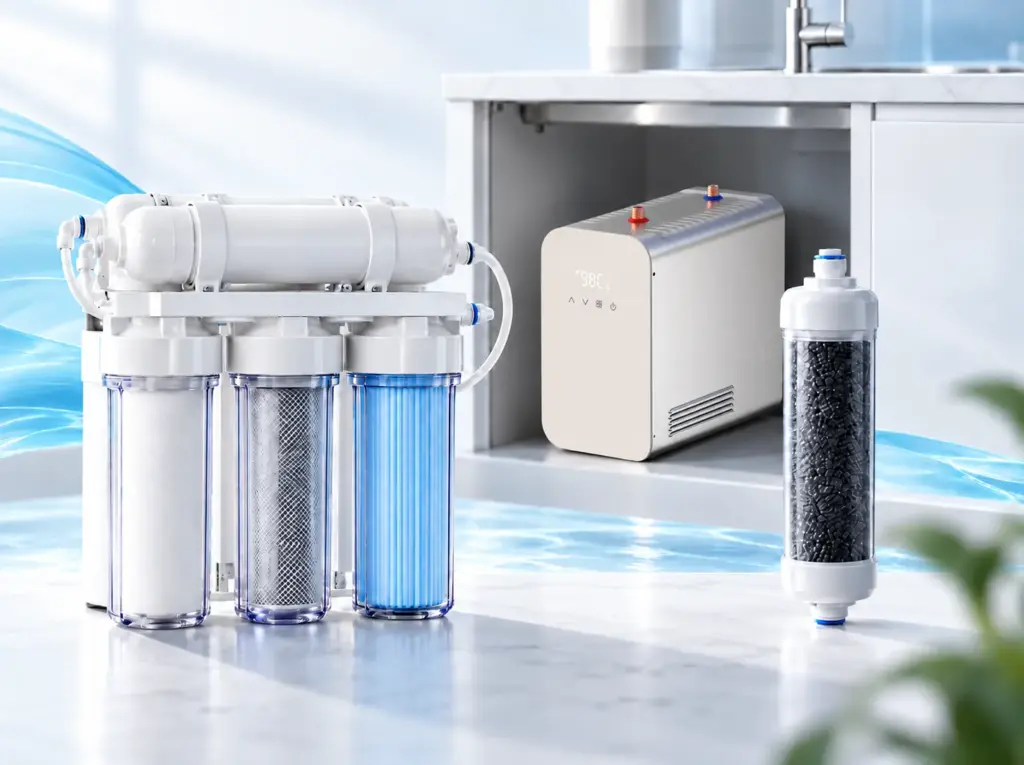
How Reverse Osmosis and Carbon Filtration Work
Activated carbon filtration uses porous carbon media to adsorb certain substances from water. Activated carbon can also reduce residual chlorine through chemical reactions. It is widely used to improve taste and odor in treated municipal drinking water.
Carbon filter performance depends on the media, cartridge design, contact time, operating flow, and the contaminants involved. Some specially designed and certified carbon filters can reduce substances such as lead or certain PFAS, but these capabilities should never be assumed for every cartridge.
Reverse osmosis uses pressure to move water through a semipermeable membrane. The process separates treated water from a concentrate stream containing substances rejected by the membrane.
RO can reduce many dissolved salts, hardness minerals, and specific chemical contaminants. Actual removal performance depends on membrane design, feed-water quality, pressure, temperature, and operating conditions.
The two technologies are not necessarily alternatives.
Many RO systems use carbon pre-filtration to reduce chlorine and protect chlorine-sensitive membranes. Some also include a carbon post-filter to improve taste.
A complete RO system may therefore contain both an RO membrane and activated carbon filters.
Reverse Osmosis vs Carbon Filter: Key Differences
The following comparison covers typical water treatment characteristics rather than guaranteed performance for every filter or system.
| Comparison | Activated Carbon Filter | Reverse Osmosis System |
|---|---|---|
| Chlorine taste and odor | Common treatment purpose | Usually addressed by accompanying carbon filters |
| Dissolved salts and TDS | Generally little reduction | Can substantially reduce dissolved salts |
| Hardness minerals | Standard carbon filters do not significantly reduce calcium and magnesium | Can reduce hardness minerals |
| Lead and certain PFAS | Some specifically certified filters can reduce them | Some specifically certified RO systems can reduce them |
| Water supply | Usually treats water as it passes through the cartridge | Membrane production rate may require additional storage |
| Wastewater | Normally no separate concentrate stream | Produces concentrate water |
| Maintenance | Cartridge replacement | Pre-filters, membrane, and other system components |
A filter’s technology alone does not establish which contaminants it can reliably reduce.
For example, a standard carbon cartridge designed for chlorine taste and odor should not be treated as a nitrate-removal solution. Similarly, an RO system should not be assumed to remove every possible contaminant.
The CDC’s drinking-water filter guidance recommends checking the substances a particular filter is designed to remove.
Which Filter Is Better for Different Water Conditions?
Municipal Water With Chlorine Taste or Odor
For municipal drinking water that already meets applicable safety requirements, the main concern may be unpleasant taste or residual chlorine.
A suitable activated carbon filter may be sufficient.
It can improve the drinking experience without the additional components, concentrate-water discharge, and maintenance associated with RO.
Buyers should still check the cartridge’s treatment capacity, rated flow, replacement interval, and specific performance claims.
Where the utility uses chloramine rather than free chlorine, filter selection requires additional care. Not every carbon cartridge provides the same chloramine-reduction performance.
Water With High TDS or Dissolved Contaminants
RO becomes more relevant when water analysis identifies dissolved substances that need to be reduced.
Depending on the membrane and complete system, these may include dissolved salts, nitrate, fluoride, or other specific contaminants.
A TDS measurement can help assess the overall concentration of dissolved substances, but TDS alone does not establish whether drinking water is safe. It does not identify the individual substances present or their health significance.
Before selecting a filtration system for an office, restaurant, or commercial project, review the local water quality report or obtain appropriate water analysis.
Where the source water is unsafe or its quality is unknown, treatment must be designed and verified against the actual water quality risks. Neither an ordinary carbon cartridge nor an unspecified RO system should be assumed to make all water safe to drink.
Hard Water and Scale Control
Hard water introduces another consideration, particularly for dispensers with heating elements.
Ordinary activated carbon does not significantly remove calcium and magnesium, the main minerals responsible for water hardness.
RO can reduce these minerals, but high-hardness water can also cause scaling on the RO membrane. Pretreatment may be necessary.
The appropriate solution depends on water hardness, equipment design, maintenance requirements, and the desired treated-water characteristics.
For a broader look at water quality and commercial equipment selection, see JNOD’s Commercial Water Dispenser for Office guide.
How Filtration Affects Water Dispenser Performance
A filtration system can provide suitable treated water but still fail to meet the dispenser’s operating requirements.
Three specifications are particularly important:
Dispensing flow rate describes how quickly water can leave the tap.
Chilled-water production capacity describes how much chilled water the cooling system can produce under specified conditions.
RO production rate describes how quickly the membrane system can supply treated water under its rated conditions.
These values measure different things and should not be used interchangeably.
An Example: Tap Flow Is Not Cooling Capacity
Consider a hypothetical under-counter dispenser with a maximum tap flow rate of 2.5 L/min and a rated chilled-water production capacity of 20 L/h.
At 2.5 L/min, a 1-liter bottle could be filled in approximately 24 seconds, assuming the rated flow is maintained.
That does not mean the dispenser can continuously produce 2.5 liters of chilled water every minute.
A flow of 2.5 L/min is equivalent to 150 L/h if maintained for an entire hour, far above the stated 20 L/h cooling capacity.
The system may supply water quickly from its chilled-water reservoir during short dispensing periods. However, sustained demand can exceed its ability to cool incoming water, depending on storage volume, inlet temperature, and rated test conditions.
An RO system connected upstream introduces a third limit: how quickly treated water can be produced and made available to the dispenser.
A high tap flow rate cannot compensate for insufficient RO production or chilled-water recovery.
This distinction matters in offices, cafés, and other locations where several users may fill bottles within a short period.
Before specifying a system, compare expected peak demand with filtration output, available storage, dispenser inlet-pressure requirements, and cooling capacity.
Compatibility With Under-Counter and Sparkling Water Dispensers
Under-counter systems often combine a chiller, pump, water reservoir, faucet, and sometimes a carbonation unit inside a limited space.
Adding RO may introduce a storage tank, additional filters, pressure-control components, and a concentrate-water drain.
Even when a dispenser supports RO-treated water, the proposed filtration system must provide suitable inlet pressure and sufficient water at the required rate.
Water mineral content can also influence the taste of still and sparkling water. Depending on the project, buyers may consider blending or remineralization after RO treatment.
JNOD offers under-counter sparkling water chillers, including product configurations described as RO-compatible. Exact inlet conditions and supported filtration arrangements should be confirmed for the model being supplied.
A product described as RO-compatible should not automatically be considered compatible with every RO membrane, storage tank, or pressure configuration.
Installation, Wastewater, and Maintenance Costs
Activated carbon filtration is generally simpler to integrate into a water dispenser.
A typical inline system needs suitable connections, adequate water pressure, and enough access for cartridge replacement. It normally does not produce a separate concentrate-water stream.
RO installations require more planning.
Depending on the design, they may need pre-filtration, a membrane, storage or pressure-management components, and a suitable drain for concentrate water.
This can become important in a compact cabinet that already contains a chiller, hot-water unit, CO₂ cylinder, or other equipment.
How Much Water Does RO Waste?
There is no universal wastewater ratio for RO systems.
The US Environmental Protection Agency notes that a typical point-of-use RO system can produce five gallons or more of reject water for every gallon of treated water.
In contrast, point-of-use RO systems qualifying for the EPA WaterSense label must meet a limit of no more than 2.3 gallons of reject water per gallon of treated water.
These figures apply to the equipment types and conditions addressed by the EPA program, not to every commercial installation.
See the EPA’s guidance on point-of-use RO systems.
For a commercial project, ask for the actual system’s treated-water production, recovery or reject-water performance, and the conditions under which those values were measured.
Maintenance requirements should also be included in the comparison.
Carbon systems generally require periodic cartridge replacement. RO systems may involve pre-filters, membrane replacement, storage-system maintenance, sanitation, and additional components.
For distributors and commercial operators, replacement costs, service access, and spare-parts availability can affect the long-term value of the installation.
Check Filtration Performance Claims
Filtration standards can help buyers assess whether a product has been evaluated for a particular purpose.
NSF/ANSI 42 covers specified aesthetic-effect claims, NSF/ANSI 53 addresses specified contaminant-reduction claims associated with health effects, and NSF/ANSI 58 applies to reverse osmosis drinking-water treatment systems.
Certification to a standard does not automatically mean every possible contaminant-reduction claim is covered.
Check the exact product and its certified claims through the relevant listing.
The official NSF water treatment standards guide provides further details. For model-specific certification checks, see JNOD’s Water Dispenser Certifications guide.
What Should Buyers Confirm Before Ordering?
For a commercial water dispenser, a useful filtration specification should establish four things: the incoming water quality, required treatment performance, available water supply, and compatibility with the dispenser.
Ask the supplier to confirm the filter’s rated flow, operating pressure, capacity, and maintenance requirements.
For RO systems, also review the membrane production rating, feed-water test conditions, available storage, concentrate-water connection, and expected output under local operating conditions.
The dispenser’s heating, chilling, or carbonation requirements must be considered alongside the filtration system.
For OEM and ODM projects, these decisions should be made before the cabinet layout and component specifications are finalized. Filter dimensions, tubing connections, service access, and local water conditions can affect the equipment design.
Which Is Better: Reverse Osmosis or Carbon Filtration?
Activated carbon may be sufficient when the water already meets applicable drinking-water requirements and the main objective is to improve chlorine taste or odor.
RO may be more suitable when water analysis identifies dissolved substances that require additional treatment. In many installations, both technologies work together.
For water dispensers, the final decision also depends on flow, pressure, storage, drainage, maintenance, and equipment compatibility.
The best filtration system is the one that meets the water treatment objective without compromising dispenser performance.
For JNOD under-counter water dispenser projects, buyers can share their water analysis, proposed filtration system, and expected daily demand through our project inquiry page when discussing a suitable product configuration.
 English
  Arabic
  Russian
  Spanish