
Quick Answer: Operating a commercial or residential sparkling water dispenser reliably comes down to CO₂ quality, cylinder threading, and precise line pressure. Always source beverage-grade CO₂ (99.9% purity) to avoid off-tastes and system contamination. For engineers and facility managers, standardized CGA-320 or TR21-4 valves ensure seamless cylinder hot-swaps without gas leaks.
The Real Reason Your Sparkling Water Tastes Flat
We frequently assist facility managers and commercial kitchen installers who struggle with inconsistent carbonation. A common scenario involves a high-end sparkling water unit that suddenly produces flat water or develops gas regulator leaks after just a few cylinder replacements. In most cases, the dispenser hardware is operating correctly; the root cause is usually poor CO₂ gas purity, line pressure drops, or mismatched cylinder valves. At JNOD, we design integrated carbonation blocks for commercial and residential applications, and field data shows that reliable micro-bubbling depends directly on gas quality and precise temperature management.
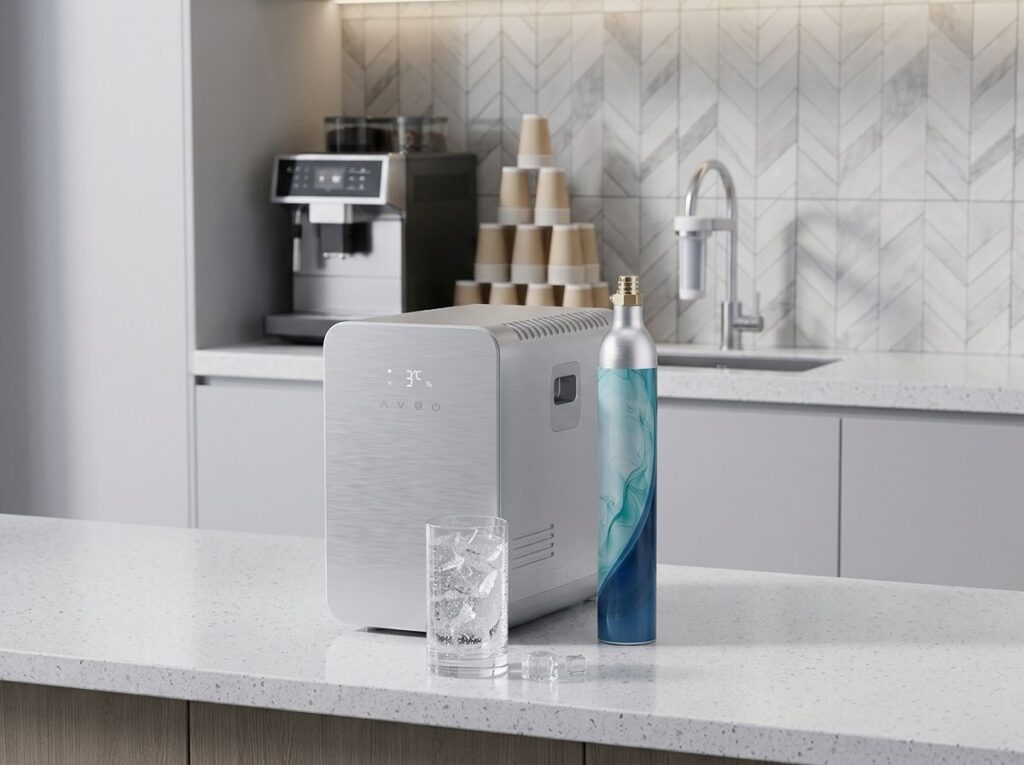
Technical Factors: Sourcing the Right CO₂ Gas
Not all gas cylinders are interchangeable, and using industrial-grade gas in drinking systems creates long-term maintenance issues.
1. Gas Purity Grades
Beverage-grade CO₂ is required for all food-service applications. Industrial-grade CO₂ contains trace amounts of benzene, hydrocarbons, and moisture that contaminate internal check valves and degrade beverage taste. Beverage systems require a minimum gas purity of 99.9% (ISBT Food Grade Standard). According to safety and quality guidelines published by the Compressed Gas Association (CGA), using certified food-grade cylinders prevents internal regulator corrosion and protects consumer health. Using clean gas ensures the carbonator block operates without valve sticking.
2. Cylinder Valve Standards
Valve threads often confuse system specification and refill cycles. Standard commercial kegerators and under-sink carbonators in North America use CGA-320 threads, while European systems typically use BS341 No. 8 fittings. Compact countertop units frequently use quick-connect TR21-4 threaded cylinders. Verifying the regulator thread specification before ordering bulk refills prevents air leaks and damaged threads.
Carbonation Physics: Pressure, Temperature, and Flow
Achieving persistent micro-bubbles in water relies on fluid temperature and controlled gas absorption.
The Thermal Factor
Cold water absorbs carbon dioxide much more efficiently than warm water. If incoming water enters the carbonation block above 10°C, the gas cannot bind effectively to the water molecules. When the water is dispensed, the undissolved gas escapes rapidly into the air, leaving the drink flat. JNOD carbonation systems utilize integrated chillers to maintain the internal mixing chamber at a constant 4°C, maximizing gas dissolution and retention.
Dynamic Line Pressure
Gas regulation requires a balance between flow rate and pressure limits. Most under-sink carbonators operate best between 3.5 bar and 4.5 bar (50 to 65 PSI). Operating below 3.5 bar results in weak carbonation, while pressure exceeding 4.5 bar can trip safety relief valves and vent gas into the cabinet space. High-performance units use dual-stage regulators to deliver constant output pressure even as the supply cylinder empties.
Product Spotlight: JNOD Commercial Sparkling Water Module
Designing a compact carbonation block that fits inside standard kitchen cabinetry requires addressing fluid backflow and pressure stability.
The Problem: Carbonation Chamber Flooding
Standard carbonation tanks often experience solenoid valve wear over time. When cheap solenoid seals degrade, water can backflow into the CO₂ gas line, or high-pressure gas can migrate back into the main water supply. This cross-contamination causes pump cavitation and leads to premature element failure.
The Solution: JNOD Integrated Dual-Check Carbonator
To eliminate cross-contamination, JNOD engineered an integrated stainless-steel carbonation module featuring dual food-grade check valves and an auto-purging gas loop. The module connects directly to commercial CO₂ cylinders and includes an inline pressure sensor that cuts off pump operation if gas pressure drops below 2.5 bar. According to drinking water quality research by the U.S. Environmental Protection Agency (EPA), maintaining closed-loop integrity is essential for preventing bacterial growth in stagnant lines. This design maintains steady water temperature, stable pressure, and fine gas dispersion for optimal carbonation.
Technical Comparison: CO₂ Sourcing Options
| Sourcing Option | Purity Rating | Refill Method | Best Application Scenario | Engineering Considerations |
| Small Gas Cylinders (60L) | 99.9% (Food Grade) | Direct Exchange / Retail | Low-volume residential / Compact office | Higher cost per liter; requires frequent replacements |
| Refillable Bulk Tanks (5lb–20lb) | 99.9% (Beverage Grade) | Local Gas Supplier Exchange | Commercial offices, cafes, restaurants | Requires cabinet space & standard CGA-320 regulator |
| On-Site Micro-Bulk System | 99.95%+ | Cryogenic Tank Truck Refill | High-traffic venues, cafeterias | High initial equipment cost; requires external safety venting |
Troubleshooting Guide: Common Field Failures
When a sparkling water dispenser stops performing correctly, evaluating three primary mechanical checkpoints usually resolves the issue.
Symptom: Water Tastes Flat
Check the incoming water temperature first. If the cooling module fails and water temperature rises above 12°C, carbonation efficiency drops by more than 40%. Next, check the regulator gauge. If output pressure falls below 3.0 bar, adjust the regulator valve to restore correct operating pressure.
Symptom: Sputtering Dispense
Sputtering usually indicates an air lock or interrupted water supply. When inlet water pressure drops, the carbonator pump draws excess gas into the delivery line. Inspect the inlet water pressure-reducing valve and ensure the main supply line remains fully open.
Conclusion: Reliable Carbonation Starts at the Source
Consistent carbonation relies on predictable fluid mechanics and clean gas inputs. Selecting beverage-grade CO₂ and matching regulator threads properly eliminates the majority of field service calls. JNOD builds commercial-grade sparkling water modules designed for high daily usage, helping contractors and facility managers maintain stable pressure and reliable operation over long service cycles.
FAQ
What is the difference between food-grade CO₂ and industrial CO₂?
Food-grade CO₂ undergoes specialized filtration to eliminate hydrocarbons, benzene, and excess moisture, achieving at least 99.9% purity. Industrial CO₂ can contain trace oil residues from compressors that contaminate water lines and cause internal check valves to stick. Always specify beverage-grade gas for drinking systems.
How long does a standard 5lb CO₂ tank last on a sparkling water dispenser?
A 5lb CO₂ cylinder typically carbonates between 350 and 450 liters of water. The exact yield depends on the target carbonation level (grams of CO₂ per liter) and operating water temperature, as colder water requires less gas pressure to achieve optimal carbonation.
Can I connect a JNOD sparkling water dispenser to a large commercial gas cylinder?
Yes. JNOD commercial carbonation modules feature standard inlet connectors that attach to 5lb, 10lb, or 20lb bulk gas cylinders using standard CGA-320 pressure regulators.
Upgrade Your Carbonation Infrastructure
Avoid service interruptions caused by low gas purity or leaking regulator fittings. JNOD engineers high-efficiency sparkling water modules, chillers, and dispensers built for reliable commercial operation and easy smart home integration.
Contact JNOD’s Technical Application Team today to review engineering drawings, request system documentation, or receive an OEM quote for your next project.

 English
  Arabic
  Russian
  Spanish