
How much electricity does a water dispenser use? Consumption varies with the equipment’s heating and cooling functions, water demand, standby losses, and operating conditions.
For example, a dispenser consuming 1.2 kWh per day would use approximately 36 kWh over 30 days, costing $7.20 at an electricity rate of $0.20/kWh. This is an illustrative calculation, not a typical consumption rating or a JNOD product test result.
A basic ambient-water dispenser may use very little electricity, while systems that heat, chill, or carbonate water have additional electrical loads.
Water dispenser power consumption should be evaluated in kilowatt-hours (kWh), not estimated from rated wattage alone.
For offices, hospitality businesses, and equipment buyers, this distinction is essential when comparing operating costs.
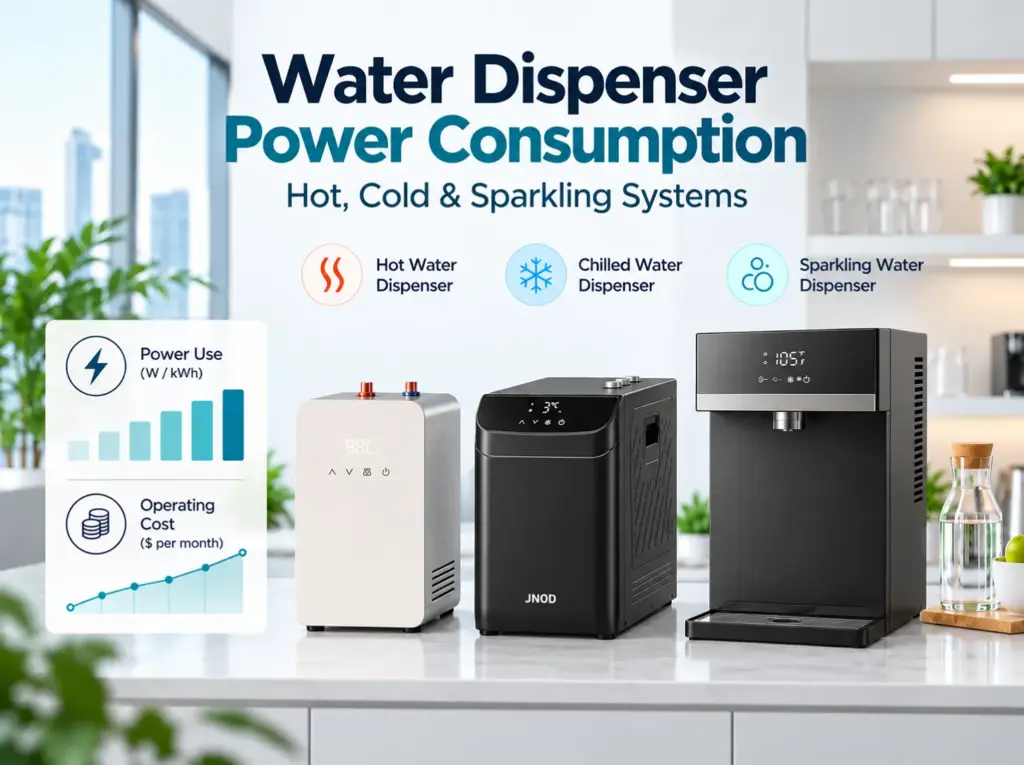
Water Dispenser Wattage vs Actual Electricity Consumption
Watts (W) describe the rate at which equipment uses electricity. Kilowatt-hours (kWh) measure the electrical energy consumed over time.
For example, JNOD’s countertop sparkling and chilled water dispenser lists a rated power of 205W for its ST32AU and ST32AE configurations.
If a 205W electrical load operated continuously for 24 hours, it would consume:
205W × 24 hours ÷ 1,000 = 4.92 kWh
However, this is a hypothetical continuous-load calculation, not the dispenser’s measured daily consumption.
In actual operation, the refrigeration compressor cycles according to water temperature and demand. Electronic controls may consume smaller amounts of electricity between cooling cycles.
The same principle applies to hot-water equipment. A 1,500W heating element does not necessarily draw that power continuously while the dispenser is switched on.
Rated power helps determine electrical supply requirements. Actual running costs depend on how much energy the appliance consumes throughout the day.
Hot, Cold and Sparkling Water Dispensers Compared
Different dispensing functions create different electrical loads.
| Water Dispenser Type | Main Electrical Loads | Factors Affecting Consumption |
|---|---|---|
| Ambient water dispenser | Controls and pump, if fitted | Pump operation, standby electronics |
| Instant hot water dispenser | Heating element and controls | Water volume, inlet and target temperatures |
| Storage-type hot water dispenser | Heater and temperature controls | Hot-water demand, insulation, standby losses |
| Chilled water dispenser | Compressor, fan and controls | Cooling demand, ambient temperature |
| Hot and cold water dispenser | Heating and refrigeration | Hot and chilled water demand |
| Chilled and sparkling water dispenser | Refrigeration, pumps and controls | Cooling demand, dispensing frequency |
The table identifies the main sources of electricity consumption, rather than ranking equipment by efficiency. Two dispensers with similar functions may perform differently because of their design and operating conditions.
Hot Water: Heating Demand and Standby Losses
Instant hot-water dispensers use electric heating elements to raise water temperature. A higher heating power can provide faster heating, but it does not automatically mean higher daily energy consumption.
Energy demand depends primarily on the quantity of water heated and the required temperature rise, together with system losses.
Storage-type dispensers also consume electricity to maintain their stored water temperature. Insulation and standby heat loss therefore become important when water demand is low.
Neither heating arrangement is universally more efficient without considering equivalent operating conditions.
JNOD’s instant hot water dispenser range includes different configurations for residential and commercial applications.
Chilled and Sparkling Water: Refrigeration Demand
Chilled-water dispensers use refrigeration systems to remove heat from incoming water. The compressor may stop when the desired temperature is reached and restart as cooling demand increases.
A dispenser supplying 3°C water generally requires more cooling than one supplying 12°C water under otherwise comparable conditions.
Sparkling water dispensers often combine refrigeration with pumps, valves, and electronic controls. Carbonation using a pressurized CO₂ cylinder does not itself require an electric compressor to produce the gas on-site.
For many chilled sparkling systems, refrigeration remains a major electrical load. Adding carbonation therefore does not create a universal percentage increase in electricity consumption.
What Affects Water Dispenser Energy Consumption?
The number of users matters, but actual consumption is also influenced by water temperature, daily dispensing volume, insulation, ambient conditions, and operating schedules.
A busy café may dispense substantially more hot or chilled water than a small office. However, an office dispenser left running overnight can still consume electricity to maintain temperatures while nobody uses it.
Installation conditions also affect refrigeration performance. An under-counter unit requires adequate ventilation to reject heat. Restricted airflow can increase operating temperatures and reduce cooling efficiency.
Similarly, heating water to a higher temperature requires more energy, while poorly insulated storage systems may need more frequent reheating.
Selecting a suitable capacity and installation arrangement helps balance performance with running costs.
For further guidance on capacity and installation planning, see JNOD’s Commercial Water Dispenser for Office guide.
How Much Energy Does It Take to Heat Water?
A simple engineering calculation explains why heater wattage is not the same as energy consumption.
Suppose an office uses 10 liters of hot water per day, heated from 20°C to 90°C.
The temperature rise is 70°C.
The theoretical energy required is:
Energy = Water Mass × Specific Heat Capacity × Temperature Rise
Assuming water density is approximately 1 kg/L:
10 kg × 4.186 kJ/(kg·°C) × 70°C ÷ 3,600
= approximately 0.81 kWh of thermal energy
This represents the energy transferred to the water, excluding heat lost through the appliance, storage tank, or pipework.
Actual electrical consumption also depends on equipment efficiency, controls, and standby losses.
Two heaters with different rated powers can require similar useful heating energy to raise the same quantity of water through the same temperature difference. The higher-power heater may simply complete the process faster.
This is why equipment efficiency should not be judged by wattage alone.
How to Calculate Monthly Water Dispenser Electricity Cost
Measuring actual electricity consumption is more reliable than estimating it from the nameplate.
A suitable energy meter can record consumption over a representative period, including normal operating hours and periods without water use.
The basic formula is:
Monthly Cost = Daily Consumption (kWh) × Days × Electricity Rate
Consider a hypothetical office dispenser with these results:
- Energy measured over seven days: 8.4 kWh
- Average daily consumption: 1.2 kWh
- Electricity rate: $0.20/kWh
The estimated monthly electricity cost is:
1.2 × 30 × $0.20 = $7.20
The example assumes similar operation throughout the month. It is not a measured JNOD product result.
For more representative data, include working and non-working days if the dispenser remains powered continuously. A single busy weekday or an overnight standby measurement may not reflect normal monthly energy use.
Commercial electricity bills may also include demand charges, fixed fees, or time-of-use pricing.
For larger projects, compare equipment using consistent measurement periods, temperature settings, and water-demand conditions.
What Does ENERGY STAR Say About Water Dispenser Efficiency?
ENERGY STAR provides a useful reference for comparing eligible water coolers.
Its Version 3.0 specification includes an On Mode with No Water Draw test. This measures energy consumption while the dispenser maintains its operating temperatures without water being withdrawn.
Under this specification, the qualification limits include:
- Cold-only and cook-and-cold units: ≤ 0.16 kWh/day
- Low-capacity hot-and-cold units with conditioned storage: ≤ 0.68 kWh/day
- High-capacity hot-and-cold units with conditioned storage: ≤ 0.80 kWh/day
- Hot-and-cold units with on-demand heating: ≤ 0.18 kWh/day
These are ENERGY STAR qualification limits under defined testing conditions, not typical daily electricity consumption figures.
They do not mean every cold-water dispenser consumes 0.16 kWh per day, nor do they demonstrate that any JNOD model meets ENERGY STAR requirements without verified certification.
Actual energy consumption can be higher when users regularly dispense hot or chilled water.
Product eligibility also matters. ENERGY STAR covers certain bottled and point-of-use water coolers, including eligible products with additional sparkling-water functions. However, some non-freestanding pressurized units, such as under-sink or building-integrated systems, fall outside this product category.
Buyers should therefore avoid applying ENERGY STAR water cooler ratings directly to every under-counter appliance.
The official ENERGY STAR Water Coolers page provides further information about the requirements and certified products.
How to Reduce Water Dispenser Running Costs
Start by selecting equipment that matches actual water demand.
An oversized system may maintain more heated or chilled water than necessary, while an undersized unit may struggle during peak use.
Temperature settings should also reflect the application. If users do not need the highest available hot-water temperature or the coldest setting, an appropriate adjustment can reduce heating or cooling demand.
Where available, scheduled operation or energy-saving modes may help reduce consumption during long unused periods. These settings should follow the manufacturer’s hygiene, safety, and operating instructions.
Regular maintenance matters as well. Follow the recommended procedures for ventilation, condenser cleaning, scale control, and inspection.
The resulting savings depend on the equipment and operating conditions. They should be verified through measurement rather than expressed as a fixed percentage.
What Should Commercial Buyers Check Before Ordering?
For distributors, importers, and project buyers, electricity consumption should be evaluated alongside capacity, installation, and maintenance requirements.
Ask the manufacturer for the product’s rated power, voltage, frequency, available energy-consumption test results, and the conditions under which the measurements were taken.
It is useful to distinguish between three figures:
Rated power: The specified electrical power of the equipment.
Standby or no-water-draw consumption: Electricity used while maintaining operating conditions without dispensing water.
Consumption during normal use: Energy required under a defined dispensing and operating schedule.
When comparing multifunctional dispensers, confirm whether the reported figures cover the complete appliance and which functions were active during testing.
If an energy-saving mode is available, check whether it changes water availability or recovery time.
The lowest rated power does not necessarily indicate the lowest running cost. A meaningful comparison requires energy measurements under similar conditions.
For broader product selection, see JNOD’s Commercial Water Dispenser Buying Guide.
Final Thoughts
Water dispenser electricity consumption depends on equipment design, heating and refrigeration demand, standby losses, and actual use.
Rated wattage alone cannot reliably predict monthly electricity costs. Buyers should compare measured kWh data under representative conditions and apply their local electricity rates.
For office, hospitality, or OEM/ODM projects, contact JNOD to discuss the required water functions, dispensing capacity, and available technical specifications for your intended configuration.
 English
 Arabic
 Russian
 Spanish