
A 5-in-1 water system is not automatically better than a 3-in-1 or 4-in-1 configuration. The right choice depends on the water functions users need, the equipment installed beneath the counter, and the project’s installation requirements.
For distributors, kitchen brands and project buyers, comparing 3-in-1 vs 4-in-1 vs 5-in-1 water systems involves more than counting functions. Different configurations may require different faucets, heating and cooling modules, water connections and control methods.
Respuesta rápida: In the JNOD configurations compared here, a 3-in-1 system provides filtered, chilled and sparkling water. A 4-in-1 system adds boiling (hot) water, while a 5-in-1 system adds regular cold water. The main differences lie in the water functions, under-counter equipment and plumbing arrangements.
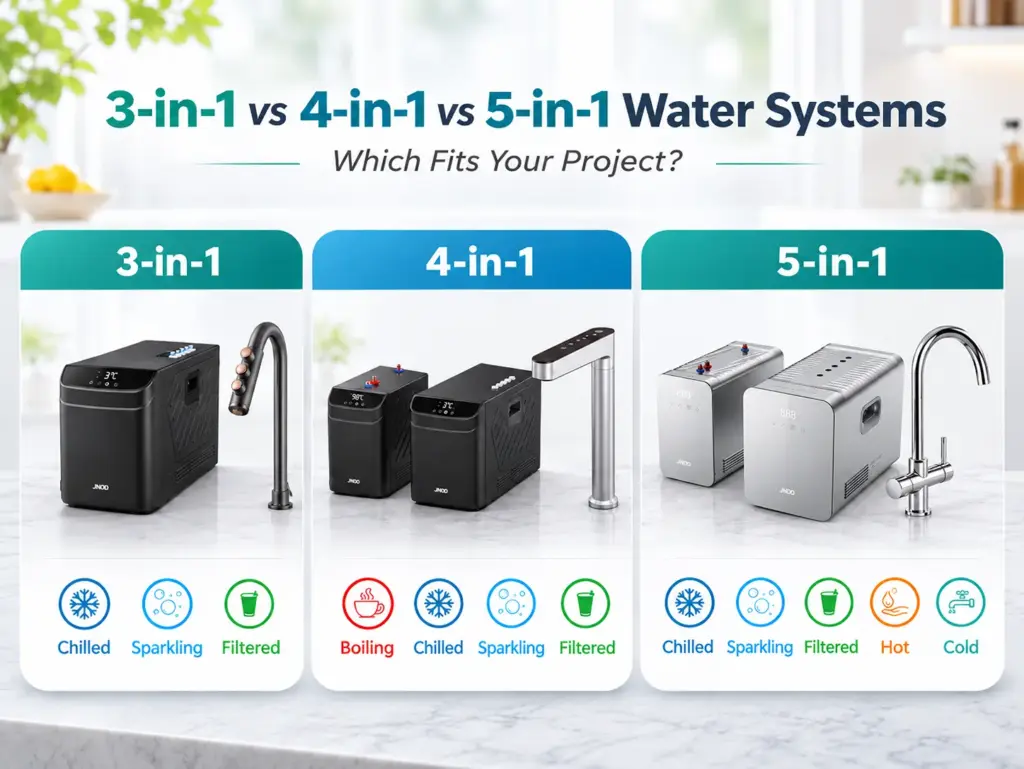
3-in-1 vs 4-in-1 vs 5-in-1 Water Systems: Key Differences
The following table compares three JNOD configurations using their corresponding faucet models and under-counter equipment.
| Configuration | Water Functions | Faucet Model | Under-Counter Equipment |
|---|---|---|---|
| 3 en 1 | Filtered, Chilled, Sparkling | TC31MA / TC31EA | Single black chilled and sparkling water unit |
| 4-in-1 | Filtered, Chilled, Sparkling, Boiling (Hot) | T41EA | B32CE-E heating module + SC27CE-E chilled and sparkling module |
| 5-in-1 | Filtered, Chilled, Sparkling, Boiling (Hot), Cold | TC51MA | Two silver under-counter units |
These are the featured JNOD configurations, not universal definitions of multifunctional water systems. Other manufacturers and product ranges may use different combinations.
Two distinctions are particularly important.
Boiling (Hot) Water vs. Cold Water
In these configurations, Boiling y Caliente refer to the same high-temperature drinking-water function. For example, a JNOD B32CE-E heating module provides adjustable hot water up to 98°C. The term boiling does not necessarily mean that the dispenser delivers water at exactly 100°C.
Chilled Water vs. Cold Water
Chilled water is cooled by the refrigeration system to a specified temperature. Regular cold water is supplied without the same dedicated chilling process. Its actual temperature and filtration arrangement depend on the installation and water supply.
For the featured 5-in-1 configuration, the fifth function is regular cold water, not a second hot-water function.
The function count does not indicate how many modules are installed or how much water the system can dispense.
Which Configuration Fits Your Application?
3-in-1: Filtered, Chilled and Sparkling Water
De JNOD 3-in-1 water system focuses on filtered, chilled and sparkling drinking water.
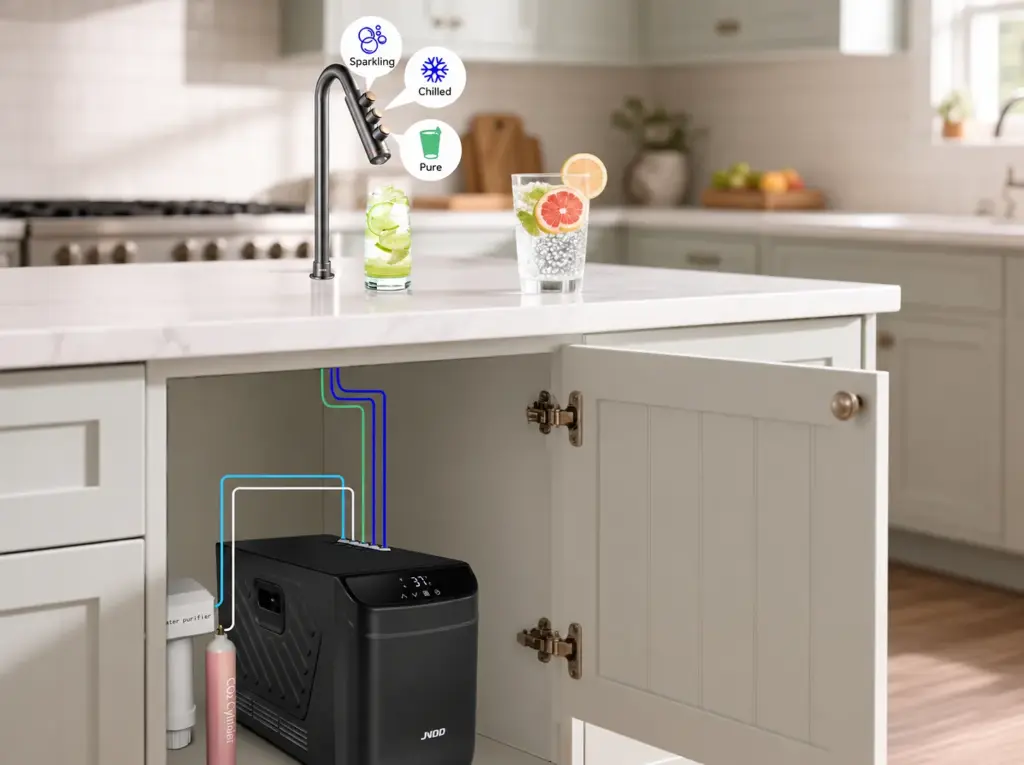
The featured configuration pairs a black under-counter unit with a TC31MA or TC31EA faucet.
The system provides chilled and sparkling water through a compact equipment arrangement without requiring a separate boiling-water module.
It may suit office refreshment areas, meeting rooms and beverage stations where high-temperature drinking water is available elsewhere or is not required.
The main selection criteria are cooling capacity, carbonation performance, dispensing flow and available installation space.
Choose this configuration when filtered, chilled and sparkling water meet the project’s requirements. Adding a heating function would provide little value if users do not need boiling water.
4-in-1: Adding Boiling (Hot) Water
De JNOD 4-in-1 water system adds boiling (hot) water to filtered, chilled and sparkling dispensing.
The featured configuration combines a T41EA faucet, a B32CE-E hot water dispenser and an SC27CE-E chilled and sparkling water dispenser.
Unlike the illustrated 3-in-1 system, this configuration uses separate appliances for heating and refrigeration.
En JNOD B32CE-E hot-water dispenser has the following specifications:
| Especificación | B32CE-E |
|---|---|
| Rated power | 1500W |
| Tank capacity | 3.2L |
| Voltage / Frequency | 220-240 V / 50 Hz |
| Adjustable water temperature | 45–98°C |
These figures apply to the B32CE-E heating module, not the combined output or electrical rating of the complete 4-in-1 system.
The additional heating function is useful where users regularly prepare tea, instant beverages or food requiring high-temperature water.
However, it also introduces another appliance, additional connections and associated electrical and service requirements.
For distributors and project contractors, the important question is whether the heating capacity and recovery performance meet the intended demand.
Choose this configuration when boiling (hot) water is required alongside filtered, chilled and sparkling water.
5-in-1: Adding Regular Cold Water
The featured JNOD 5-in-1 water system combines filtered, chilled, sparkling, boiling (hot) and regular cold water.
The illustrated configuration pairs a TC51MA faucet with two silver under-counter units.
Compared with the featured 4-in-1 configuration, the additional dispensing function is regular cold water.
This distinction matters in kitchen projects where users need both refrigerated drinking water and ordinary cold water through the same faucet.
Rather than installing a separate fixture for that additional function, the system can integrate the required water outlets into one tap, subject to the selected model’s plumbing arrangement.
However, the faucet design and internal water paths must support all five specified functions.
Buyers should confirm which outlets receive filtration, how regular cold water is supplied, and how boiling water is controlled.
The precise equipment models, connections and output temperatures should be checked against the final system specification.
Choose this configuration when the project requires all five water functions, including regular cold water, through one integrated faucet.
What Changes in the Under-Counter System?
The visible faucet is only one component of a multifunctional water system.
Different water functions require different equipment. Chilled and sparkling water need refrigeration and carbonation components, while boiling (hot) water requires a heating module.
Regular cold-water dispensing introduces another water path or outlet arrangement, depending on the faucet design.
These differences affect system performance, installation and servicing.
Heating, Cooling and Dispensing Performance
More functions do not necessarily mean higher output.
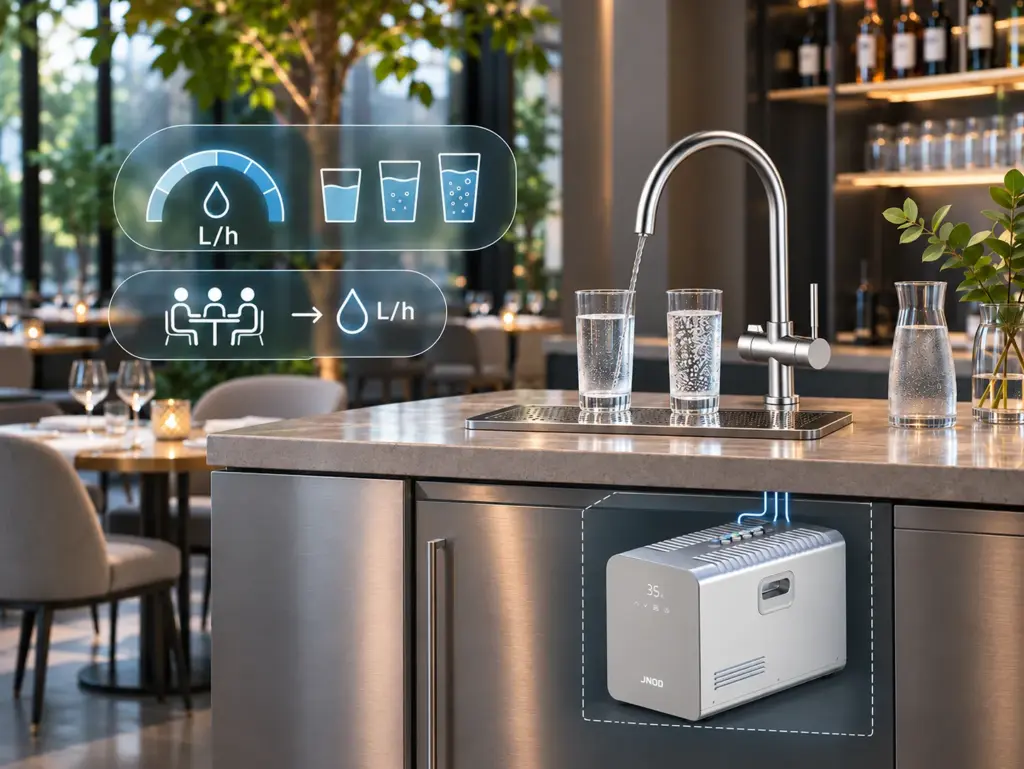
For chilled water, compare the cooling capacity in L/h and the test conditions used to establish that rating.
For dispensing, check the outlet flow rate in L/min.
A system may fill a glass quickly using stored chilled water but require additional time to cool replacement water. High outlet flow does not automatically indicate high continuous cooling capacity.
For sparkling water, consider carbonation performance, consecutive dispensing and recovery between draws.
Where a dedicated heating module is included, review its temperature range, rated power, available stored volume and heating recovery.
If heating and refrigeration are provided by separate modules, each component should be evaluated against its intended demand.
For office, hospitality and commercial projects, these performance figures may be more important than the difference between three, four or five functions.
Water Paths and Filtration
A multifunctional system may route water through different internal paths depending on the selected dispensing function.
Filtered water, chilled water, sparkling water, boiling water and regular cold water do not necessarily follow identical routes.
For example, a chilled-water function requires refrigeration, while a boiling-water function requires heating.
The filtration arrangement must also be confirmed. A water system may filter several outputs through a shared treatment stage or use a different arrangement depending on the product design.
The word filtered alone does not establish which contaminants a system can reduce.
En NSF guide to water treatment standards explains the purposes of standards such as NSF/ANSI 42, 53 and 58.
Where a project specifies water-quality requirements, buyers should request the relevant filtration specifications and supporting documentation.
A manufacturer-provided water-flow diagram is useful for checking the connections between the faucet, heater, chiller, filtration equipment and water supply.
Installation Space and Maintenance Access
The equipment arrangement directly affects the installation requirements.
The featured 3-in-1 configuration uses one main under-counter unit. The 4-in-1 example combines separate heating and cooling modules, while the illustrated 5-in-1 system uses two under-counter appliances.
A multiple-module arrangement may allow components to be serviced separately, but it also requires sufficient space for equipment, connections and maintenance.
Before installation, check the cabinet dimensions, required ventilation clearance, electrical supply, inlet water pressure and faucet mounting requirements.
Sparkling water systems also need a suitable CO₂ supply, with safe cylinder placement and replacement access.
Filters, valves and other serviceable components should remain accessible after the kitchen cabinetry is completed.
A compact faucet does not necessarily mean the complete system occupies very little cabinet space.
How to Choose the Right Configuration
The most practical approach is to separate water-function requirements from equipment performance requirements.
Start by identifying which water types users need.
If filtered, chilled and sparkling water are sufficient, a 3-in-1 configuration may meet the requirement without an additional heating module.
If users also need boiling (hot) water for drinks or food preparation, evaluate the corresponding 4-in-1 configuration.
If the project requires regular cold water alongside those four functions, the featured 5-in-1 system may offer a more suitable faucet arrangement.
Next, consider how much water users will dispense and when demand is highest.
An office refreshment area and a busy restaurant may require similar water functions but very different cooling capacities and outlet flow rates.
The same principle applies to boiling water. A heating module suitable for occasional cups of tea may not match a project requiring repeated large-volume draws.
Function count determines the types of water available; equipment capacity determines whether the system can support actual usage.
Buyers should evaluate these factors separately before selecting the final configuration.
What Should Distributors and OEM/ODM Buyers Verify?
For wholesale and customized projects, a quotation should identify the complete system rather than listing only the faucet model.
The technical specification should include the available water functions, faucet model, under-counter equipment, control arrangement and required connections.
Several details deserve particular attention.
Faucet and module compatibility: Confirm that the selected tap, heating equipment, chiller, filtration components and controls are designed to work together.
Model-specific performance: Compare heating output, cooling capacity, dispensing flow, temperature settings and operating conditions using the actual equipment model numbers.
Electrical and plumbing requirements: Check voltage, frequency, water-pressure limits, inlet connections and the requirements of the destination market.
Installation planning: Review cabinet dimensions, ventilation, mounting requirements and service access for the complete equipment arrangement.
After-sales support: Confirm the availability and compatibility of replacement faucets, controllers, filters, valves and other service components.
Compliance documentation: Determine which test reports, approvals and declarations apply to the proposed configuration.
For products placed on the European Economic Area market, the European Commission’s CE marking guidance explains the manufacturer’s responsibilities concerning applicable requirements, conformity assessment and technical documentation.
Documentation for an individual component should not automatically be treated as covering every possible combination of appliances and faucets.
For private-label projects, buyers may also need to specify faucet finishes, control interfaces, packaging, installation instructions and market-specific product configurations.
JNOD supports these requirements through its OEM/ODM services.
Reflexiones finales
The difference between 3-in-1, 4-in-1 and 5-in-1 water systems goes beyond the number of dispensing functions.
For distributors, kitchen brands and project buyers, the best choice is the configuration that provides the required water types with suitable performance, installation compatibility and service support.
Contactar con JNOD to request model-specific specifications and discuss the right water system for your project.
 English
 Arabic
 Russian
 Spanish